The Ministry of Trade and Industry (MTI) has upgraded Singapore’s GDP growth forecast for 2025 to “around 4.0%”. This is a significant increase from the “1.5% to 2.5%” growth forecast announced in August, and the “0% to 2%” growth forecast from April, following US President Trump’s “Liberation Day” tariffs.
The improved growth forecast reflects the better-than-expected performance of the Singapore economy throughout the year and its accelerating quarter-on-quarter growth. According to MTI, Singapore’s economy grew by 2.4% in the third quarter, up from 1.7% in the second quarter.
Global Economic Conditions Are More Resilient Than Expected
Earlier in the year, in response to the announcement of reciprocal trade tariffs, MTI had expected global growth to slow down in the second half of the year. However, GDP growth in many of Singapore’s key trading partners was better than expected. China and Vietnam, for example, saw year-on-year growth increase in the third quarter of 2025 compared to the second quarter. More investment into artficial intelligence (AI) also boosted US economic growth and the export of AI-related semiconductors.
Singapore benefitted from further de-escalations in trade tensions, especially that between the US and China. Trade-related sectors, including manufacturing, wholesale trade, and transportation and storage, performed better than expected due to increased domestic exports to countries such as South Korea and Vietnam. Exports to Taiwan in the third quarter of 2025 increased by 26.8%.
These then contributed positively to other parts of Singapore’s economy, including information and communications, and other professional services sectors. MTI is therefore confident about demand for AI-related electronics remaining high and supporting manufacturing and wholesale trade sectors for the rest of the year.
Downside Risks Still Remain In The Global Economy In 2026
However, that optimism is less pronounced when looking forward to 2026. MTI projects that GDP growth for Singapore, and for our trading partners in 2026 will likely be lower than 2025. MTI has forecasted a “1% to 3%” growth.
#1 The Impact of US Tariffs
Though there have been de-escalations of trade tensions between the US and many of its trading partners, the impact of the US tariffs are still expected to be felt.
China is likely to have more moderate GDP growth as exports slow and its national consumer goods trade-in program, which began in 2024, may not be as effective 2 years on. Europe’s industrial activity is also expected to slow due to the tariffs, which also means the demand for Southeast Asian exports will be affected.
#2 Concerns About Global Economic Uncertainty Persist
Though 2025 seems to have avoided the worst of it, fears about renewed escalations in tariff actions and geopolitical tensions still remain high. Any sufficiently negative change in sentiment could cause businesses and households to reduce hiring, investment and spending. This will affect broader economic growth.
Compared to 2025, manufacturing and trade-related services sectors can expect to expand at a slower pace in 2026. Semiconductor equipment makers in the precision engineering cluster may choose to take a more cautious approach in the year ahead, especially in light of the current uncertainty in the US tariff policy on semiconductors.
Consumer-facing sectors such as retail trade and the food and beverage sector will likely experience slower growth in 2026.
#3 Some Sectors In Singapore Will Still Enjoy Resilient Demand
A shift towards higher-value maintenance, repair and overhaul works in the aerospace sector, as well as strong demand for marine and offshore engineering services will continue to drive growth in the transport engineering industry.
A resilient enterprise demand for digital solutions and services will boost the information and communications sector, while macroeconomic conditions should support steady growth in the finance and insurance sectors.
The construction sector should continue to grow, as public residential building and civil engineering projects expand in 2026.
2026 Growth Forecast Is The Same As 2025’s Growth Forecast This Time Last Year
Ultimately, MTI continues to be justifiably conservative in their growth projections for Singapore’s economy. This will be the third consecutive year that MTI has forecasted a “1% to 3%” growth for the year ahead, despite registering higher GDP growth than predicted. This is because many of the geopolitical tensions felt over the past 3 years continue to weigh heavily on the world’s economies, and that uncertainty naturally affects confidence.
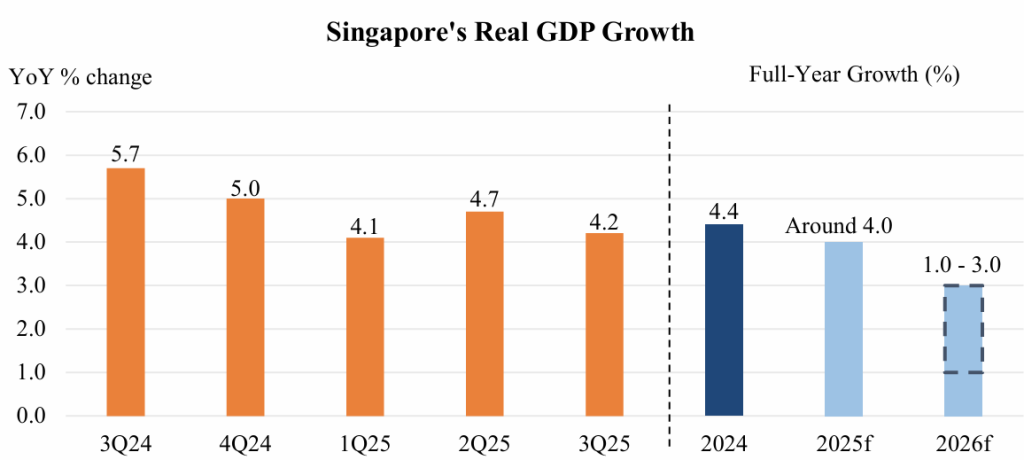
Source: MTI
Subscribe To The DollarsAndSense Business Pass
Enjoy what you are reading and want more? Join The DollarsAndSense Business Pass and unlock access to valuable tools, exclusive networking opportunities, and tap into the wisdom of industry experts to fuel your business expansion!