Singapore’s economic growth is driven by manufacturing, services, and trade. In 2025, the economy expanded by 4.8% year-on-year. Annual GDP data isn’t yet available, but in 2024, Singapore’s GDP at current market prices was over $731.4 billion. Of this, $6.6 billion came from the Arts, Entertainment, and Recreation industry. This is the second year in a row that the industry’s GDP has exceeded $6 billion, a return to pre-pandemic levels.
In 2024, over 70% of Singapore’s nominal value added was generated by the services industries, while about 25% was generated by goods-producing industries. Arts, Entertainment, and Recreation, as one of the smaller industries, gets subsumed under the umbrella term “Other Service Industries”.
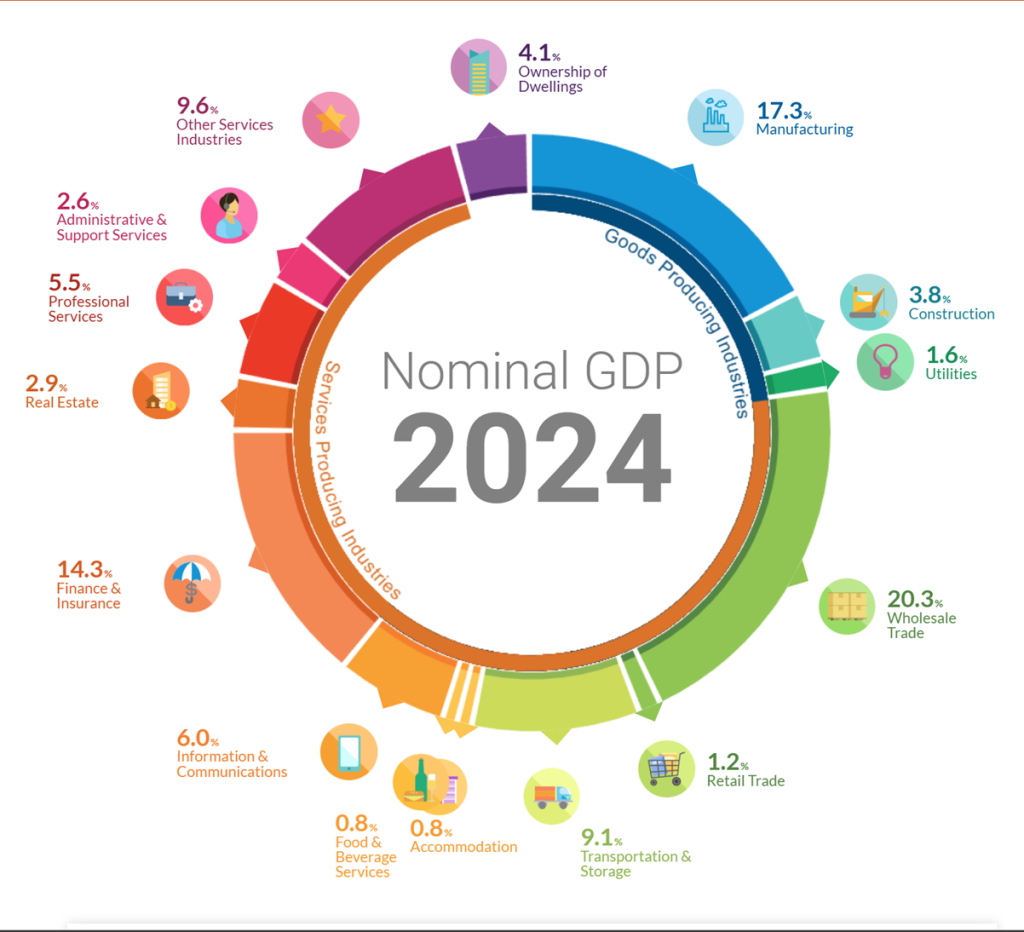
Source: SingStat
Even according to the Singapore Standard Industrial Classification 2020 (SSIC 2020), the Arts, Entertainment and Recreation section is very broad, with everything from creative, arts, and entertainment activities, to libraries, museums, and other cultural activities, to sports, gambling, and even theme parks and nightclubs. So in this crowded category, how does Singapore determine the economic value of the Arts and Culture sector?
Singapore Cultural Statistics is an annual publication co-published by the Ministry of Culture, Community and Youth (MCCY), the National Heritage Board (NHB), the National Arts Council (NAC), and the People’s Association (PA). It provides an update on the state of the arts and the cultural landscape in Singapore, including a section entitled “Economic Value of the Arts and Culture Sector”.
This section looks at two main statistics: total nominal value added and total operating receipts.
Total Operating Receipts
Operating receipts are income earned from the provision of goods and services. This includes income from consultancy and professional services, management and administrative fees, repair or service charges, rental or lease income, contract, subcontract, and commission fees, royalties and license fees, and any other operating income.
Over the past five years, the largest operating receipts have come from the photography sector, followed by film & video and the literary arts. In 2023, live performing arts and recorded music saw the biggest improvement in operating receipts over the past five years, far surpassing pre-pandemic levels.
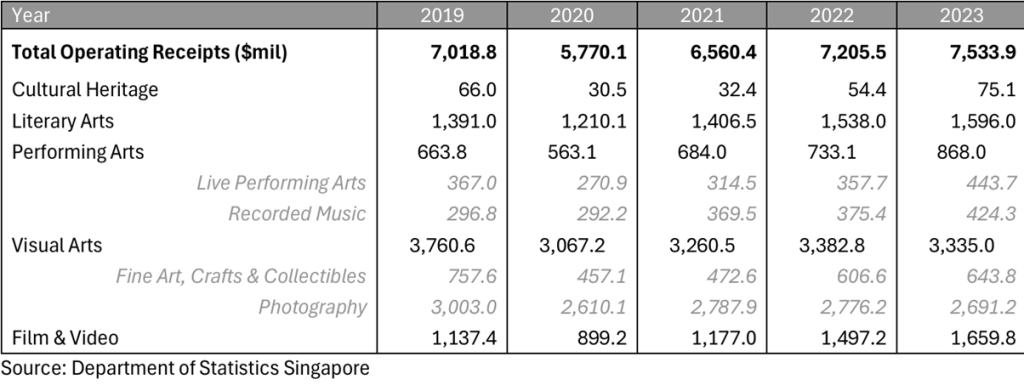
Source: Singapore Cultural Statistics 2025
It is important to note that this data excludes freelancers and independent contractors – i.e. self-employed individuals who run a business but don’t hire anyone else. These own-account workers are a significant part of these industries, so the data may not fully reflect reality.
Total Nominal Value Added
But operating receipts don’t tell the whole story. It is equivalent to simply looking at the revenue column in a company’s financial statements. That is why value added is measured by a combination of operating surplus, remuneration and taxes, less subsidies, on production
Operating surplus is defined as operating receipts, less operating expenditure and depreciation of fixed assets.
Over the past five years, the literary arts have emerged as the biggest contributor to the value added of the arts and culture industry, dethroning the photography industry.
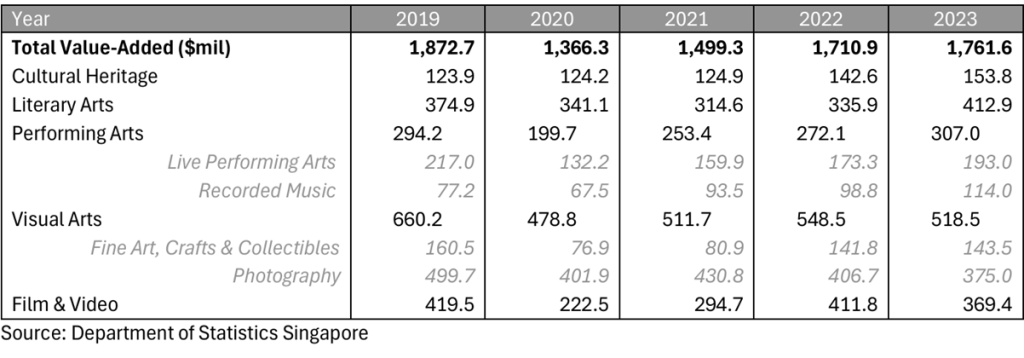
Source: Singapore Cultural Statistics 2025
Notably, once again, these statistics may not fully reflect reality as they exclude freelancers and independent contractors – i.e. self-employed individuals who run a business but don’t hire anyone else.
An Attempt To Determine The Value Added In The Arts And Culture Sector
The economic value of the arts and culture sector in Singapore is therefore based on how much they make, how much they earn, and how much they pay in taxes. It may not be the best indicator of these industries’ contributions to society, but it’s a starting point.
Beyond the headline figures of GDP and value added, Singapore recognises the importance of measuring the contributions of smaller but vital sectors, such as arts and culture. While the sector’s share of Singapore’s GDP is modest compared to finance or manufacturing, the government continues to acknowledge its significant role in contributing directly to GDP and employment, even as it is supported by sustained government funding and grants.
By embedding arts and culture within the framework of nominal value added, Singapore ensures that creative industries are recognised not only as cultural assets but also as measurable drivers of economic growth.
Subscribe To The DollarsAndSense Business Pass
Enjoy what you are reading and want more? Join The DollarsAndSense Business Pass and unlock access to valuable tools, exclusive networking opportunities, and tap into the wisdom of industry experts to fuel your business expansion!