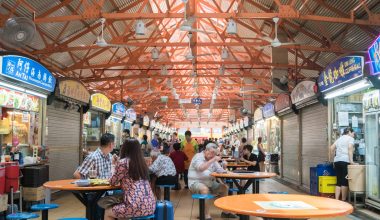
As Singapore prepares to celebrate its 60th year of independence next weekend on National Day, it’s an opportunity to celebrate our nation-building journey and reflect on our shared values. Values like multiculturalism, boldness, resilience. and openness that have united us and allowed us to prosper against the odds over the past 60 years.
A recently published book, “The First Fools: B-Sides of Lee Kuan Yew’s A-Team” is an anthology about ten of Singapore’s founding leaders. Published by The Nutgraf Books, it collects essays about familiar names including Lee Kuan Yew, Othman Wok, S.Rajaratnam and E. W. Barker.
One essay by Aaron Low is entitled “Goh Keng Swee: Business As Unusual”, a reflection on Dr Goh Keng Swee, former Deputy Prime Minister, and hailed as the “economic architect of modern Singapore”. Low writes that Dr Goh “believed in business as a means to an end, one that was for the greater good”.
Sustaining Singapore Post-Independence
Prior to independence, Dr. Goh promoted an import-substitution strategy and positioned Singapore as a manufacturing centre, with the rest of Malaysia as a hinterland. Upon realising that this was not sustainable for Singapore, Dr Goh made a fundamental strategic switch to export-oriented industrialisation. This was implemented along with the push to attract global multinational corporations to Singapore to help achieve growth.
An early example of this push for foreign direct investment by multi-national corporations was the Jurong Shipyard Company started in 1963. It was a joint venture between the Economic Development Board and Ishikawajima-Harima Industries, then one of the largest shipbuilders in the world.
Then, according to Low’s essay, came the turning point – the British announced plans to withdraw their troops from Singapore by the early 1970s. “British military bases employed close to 25,000 locals,” he writes, “while contributing close to 20% of Singapore’s GDP.”
Dr Goh spent the next decade building dozens of new companies that filled the vacuum the British left behind. He recruited top civil servants to take on various roles in these companies, including George Bogaars, who became director of Keppel Shipyard, Hon Sui Sen, who was appointed the first president and chairman of DBS, and Chandra Das, who headed Intraco, a company “that Goh set up to do business with the communist countries” as Low describes it.
First Key Principle: Companies Must Be Financially Sustainable
Dr Goh set up all these companies with the same two key principles. Firstly, the companies needed to be self-reliant – there would be “no special treatment or subsidies to help them compete against the private sector”, according to Low.
At the NTUC Income annual general meeting in 1997, Dr Goh said, “We do not own and run enterprises on ideological grounds. We also do not buy over private businesses in trouble so as to save jobs. If a government-owned enterprise loses money, it is allowed to go bankrupt and this has happened, fortunately, in very few instances. We expect government-owned enterprises to be efficient, to make money and to expand whenever feasible. These government-owned companies, in other words, are run just like private business enterprises are run or supposed to be run.”
This echoed his earlier words from a 1969 speech to the Chinese Chamber of Commerce, “We in Singapore believe in hard work. We believe that enterprise should be rewarded and not penalised. We believe that we must adjust ourselves to changing situations. We believe in seizing economic opportunities and not let them go past us. Finally, we believe in self-reliance…..These are human qualities that have helped to transform an island-swamp into a thriving metropolis. They are the traditional virtues of Singaporeans and so long as we retain these virtues, we can face the future with confidence.”
Second Key Principle: Companies Must Hire Great Talent
While Dr Goh had chosen civil servants to help him develop many of these companies, it was clear that “professionals, not politicians” had to lead them moving forward.
When recalling its history, Temasek quotes Dr Goh when he said in 1972, “One of the tragic illusions that many countries of the Third World entertain is the notion that politicians and civil servants can successfully perform entrepreneurial functions.”
“Dr Goh was very clear that politicians and civil servants should focus on what they do best, and leave businesses to entrepreneurs and professional managers,” said Temasek’s then-Executive Director and CEO, Ho Ching, in a 2009 speech.
The key, following Dr Goh’s own example, was to put in a team of competent professionals and then leave them to run the organisation the best way they saw fit.
In his eulogy for Dr Goh in 2010, then Chairman of Temasek, S Dhanabalan said, “As Minister, Dr Goh never interfered with the day-to-day operations of the government-linked companies. Even though many of the boards were headed by civil servants with no business background, he gave the boards and management the latitude to pursue their business interests according to the opportunities and imperatives of the market.”
Dhanabalan first served in DBS Bank when it was formed in 1968, rising to become its Executive Vice President at the end of his 10-year career with the bank.
As Philip Yeo, whom Low refers to as Dr Goh’s “former protégé”, sums up, “He runs the company efficiently and properly, borrows money and hires people. He is no different from a businessman. But the key difference is that Dr Goh is a state capitalist. The businessman makes profit for himself; Dr Goh did it for the public good.”
Subscribe To The DollarsAndSense Business Pass
Enjoy what you are reading and want more? Join The DollarsAndSense Business Pass and unlock access to valuable tools, exclusive networking opportunities, and tap into the wisdom of industry experts to fuel your business expansion!