
For many of us in Singapore, Saturdays are usually non-working days that we spend with our families or on personal plans. However, on Saturday, 3 May 2025, those of us who are eligible to vote will have an additional responsibility — to cast our vote.
Under Section 35 of the Parliamentary Elections Act, Polling Day on 3 May 2025 has been declared a public holiday. This means all of us, regardless of whether we are voting or not, are entitled to this public holiday.

Source: MOM
How this applies to us, whether as employers or employees, will depend on our organisation’s policies, the terms of our employment contracts, and any arrangements we have mutually agreed upon with our employers.
Saturday is A Non-Working Day For You
For those of us who do not work on Saturdays, Polling Day would be considered a public holiday that falls on a non-working day. As employees, this means we should be given either an additional day off or one extra day’s salary in lieu of the public holiday.
It’s also important to note that the following Monday, 5 May 2025, is a school holiday and not a public holiday, as some may mistakenly believe. This distinction matters because some organisations may ask their staff to take a day off on Monday, while others may prefer to credit staff with an additional day off to be used in the future.
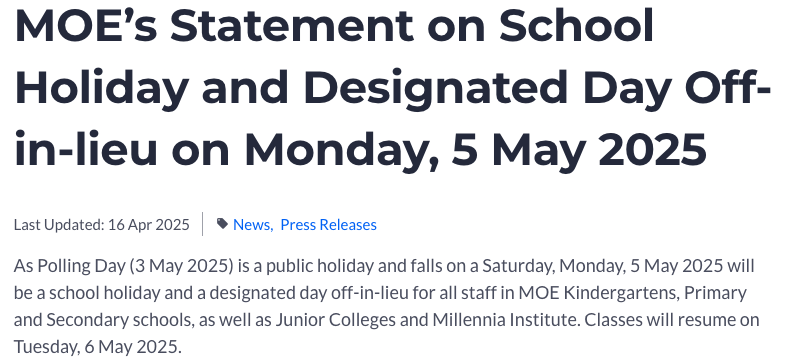
Source: MOE
Saturday Is A Working Day For You
For those of us who are scheduled to work on Saturdays, one of two outcomes may apply.
The first is that 3 May 2025 is treated by our employer as a public holiday and thus we are not required to work. Alternatively, if we are still needed to work on that day, we would be entitled to either an extra day’s salary or a day off in lieu.
Voting Is Mandatory For Eligible Singapore Citizens
In Singapore, voting is mandatory, and needing to work on Polling Day doesn’t exempt us from casting our vote.
Suppose your business needs to operate on 3 May. In that case, it may make sense to roster employees who aren’t required to vote, such as Permanent Residents, foreigners, or those under 21, so that Singaporean voters can fulfil their civic duty.
Read Also: How Much Employers Have To Pay Employees For Working On A Public Holiday?
Subscribe To The DollarsAndSense Business Pass
Enjoy what you are reading and want more? Join The DollarsAndSense Business Pass and unlock access to valuable tools, exclusive networking opportunities, and tap into the wisdom of industry experts to fuel your business expansion!


