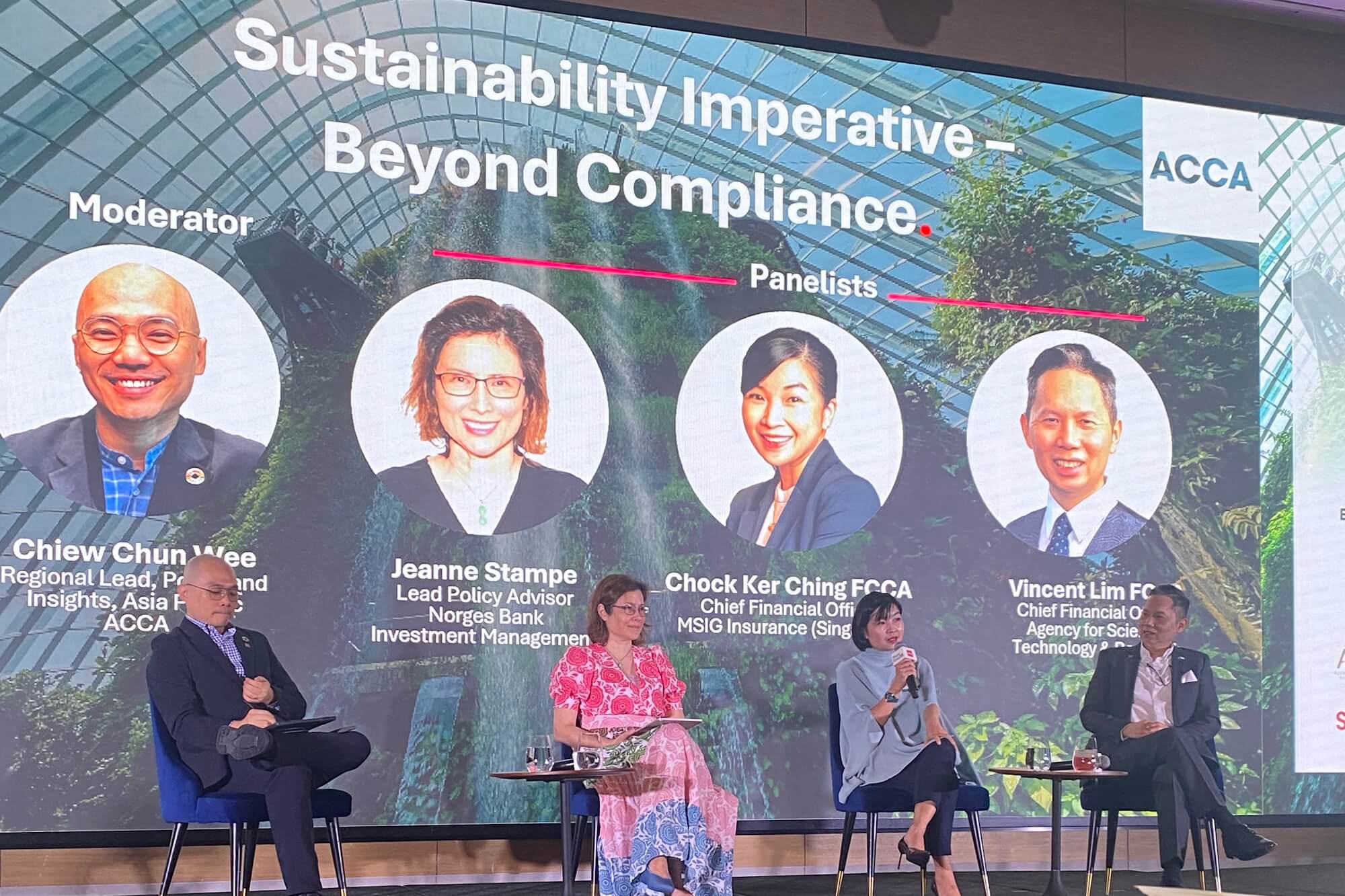
Environmental, Social, and Governance (ESG) factors are no longer just about compliance. They are reshaping corporate strategies, influencing financial decisions, and guiding risk management.
This was the clear message from a panel at the recent ACCA Annual Conference 2025. The panel included Chock Ker Ching, Chief Financial Officer of MSIG Insurance (Singapore), Jeanne Stampe, Lead Policy Advisor at Norges Bank Investment Management, and Vincent Lim, Chief Financial Officer of the Agency for Science, Technology & Research (A*STAR). The session was moderated by Chiew Chun Wee, ACCA’s Regional Lead for Policy and Insights, Asia Pacific.
During the lively panel discussion, diverse perspectives explained why companies in Singapore, particularly small and medium enterprises (SMEs), must begin treating ESG reporting as vital to their ongoing competitiveness.
Representing MSIG Insurance, Ms. Chock explained how climate risk directly affects companies. From an insurer’s perspective, businesses that are not sufficiently prepared for climate reporting face the risk of higher claims. Naturally, concerns about underwriting losses mean insurers will strategically avoid such companies.
Ms. Stampe shared a similar view. Investors naturally seek the highest possible financial returns with minimal financial risk. As one of the world’s largest funds, with investments spread across markets, countries, and currencies, Norges Bank Investment Management inherently recognises the global impact of companies that negatively affect the environment and society.
For returns to be logical, investors are more inclined to divest from companies that face considerable ESG-related financial risks. This isn’t merely a question of compliance, she insisted, and echoed Ms. Chock’s view that it’s simply a matter of strategic decision-making.
A New Set Of Globally Recognised Standards
At the United Nations Climate Change Conference in 2021, better known as COP26, the International Financial Reporting Standards Foundation (IFRS Foundation) established the International Sustainability Standards Board (ISSB).
The ISSB’s objective is to empower investors with a globally recognised framework for consolidated sustainability-related information. This data will enable companies to disclose comparable information that can be used to inform decisions on sustainability-related risks and opportunities.
In June 2023, the ISSB introduced the first IFRS Sustainability Disclosure Standards, known as S1 and S2. S1 outlines how a company prepares and reports its sustainability-related financial disclosures. S2 provides additional requirements specific to climate-related risks and opportunities. Together, these disclosure standards assist investors in assessing a company’s sustainability-related risks and opportunities over the short, medium, and long term.
As announced in August this year, the Singapore Exchange (SGX) has improved its sustainability reporting regime. It will begin incorporating the IFRS Sustainability Disclosure Standards for the financial year starting 1 January 2025. It is now mandatory for STI constituents to disclose climate-related information in line with IFRS S2. This requirement will extend to companies with a market capitalisation of $1 billion or more by the financial year 2028, and to all listed companies from the financial year 2030.

Source: Facebook/ACCA Singapore
Looking To The Future
With all this in mind, the question remained about how companies incorporate ESG into their financial strategies. A*STAR’s Dr. Vincent Lim shared four insights he expects to see in the coming years regarding ESG frameworks and standards, as well as how companies can assess the business case for ESG.
#1 Sustainability Reporting
The production of an annual sustainability report is already a requirement for SGX listed companies in Singapore. Dr. Lim expects that sustainability reporting will become more prominent, with companies expected to produce more robust reports that include climate-related disclosures, targets, and a governance structure for sustainability practices.
#2 Sustainability Verification And Validation
With globally recognised reporting standards in IFRS ISSB S1 and S2, companies cannot avoid providing material information. Sustainability reporting requires verification and validation of this information by independent third parties.
#3 Sustainability Assurance
Such verification and validation must be conducted in accordance with specific standards. In Singapore, Dr. Lim refers to the International Standard on Sustainability Assurance (ISSA) 5000, and the ISO 14064. These standards address the quantification and reporting of greenhouse gas emissions and should be fully adopted in Singapore sometime in 2027 or 2028.
#4 Sustainability Committee
Finally, Dr. Lim notes that these ESG frameworks and standards are here to stay, which means that companies will need to seriously commit resources and leadership to ensure a high standard of sustainability reporting. He recommends that companies form a sustainability committee that is well-versed in the global and Singapore-specific ESG frameworks for sustainability reporting.
Subscribe To The DollarsAndSense Business Pass
Enjoy what you are reading and want more? Join The DollarsAndSense Business Pass and unlock access to valuable tools, exclusive networking opportunities, and tap into the wisdom of industry experts to fuel your business expansion!


