
In today’s global economy, where a global company chooses to establish its headquarters is shaped by many factors. From taxation and regulation to talent acquisition and brand perception, where a company decides to place its headquarters is a statement of where it sees the company’s future.
For example, a headquarters in Singapore benefits from streamlined business registration and strong intellectual property protections, while one in the European Union (EU) must comply with the General Data Protection Regulation (GDPR) data privacy laws and stricter labour protections.
Singapore Is Popular As A Regional Base
Several global firms have relocated or expanded their headquarters to Singapore in recent years, often citing our stability, tax advantages, and strategic location as reasons for establishing operations here. According to the Singapore Economic Development Board (EDB), 46% of the top 100 MNCs chose Singapore for their regional headquarters.
When Microsoft started operating in Singapore in 1990, it was just a team of three people. Yet, it was already considered the technology giant’s regional headquarters for Asia Pacific. Today, the company boasts about 1,400 employees, many based in their relatively new offices in Frasers Tower in the heart of the CBD, which opened in 2019. Singapore is also home to three of Microsoft’s datacentres, as well as the company’s first Experience Center outside the United States and the only one in Asia.
Similarly, Google began in Singapore in 2007 with just 24 people, before moving to their iconic Google office in Mapletree Business City in 2016. Today, the company has over 3,000 employees and has invested over US$5 billion in long-term infrastructure, with four data centres.
Read Also: Why Tech Analyst Benedict Evans Insists Companies Must Be Ready For AI
Other global companies with regional headquarters here in Singapore include FedEx, which opened its new facilities at Centennial Tower in 2024, and Rolls-Royce, which opened a massive regional office in Seletar Aerospace Park in 2012 to serve the Asia Pacific region.
More recently, Danish jeweller Pandora opened new regional headquarters in Singapore last November, while South Korea’s Lotte Shopping is expected to open its international headquarters in Singapore this year. The new office aims to oversee Lotte’s businesses in Vietnam and Indonesia, where they have a sizeable retail presence.
With so many diverse brands setting up regional headquarters in Singapore, the argument can also be made that such a move signals a company’s desire to be associated with Singapore’s reputation for innovation, efficiency, and global connectivity.
Brand Perception Is Also About Trust
In fact, as the recently released Edelman Trust Barometer 2026 demonstrates, the country’s headquarters plays a role in building foreign trust in a brand. As part of their extensive annual survey, the study asks “How much you trust global companies headquartered in the following markets to do what is right”. The data excludes respondents from the country being rated, ensuring that the data reflects solely foreign perceptions.
In the Edelman Trust Barometer 2026, Singapore was included for the first time, receiving a neutral score of 52.
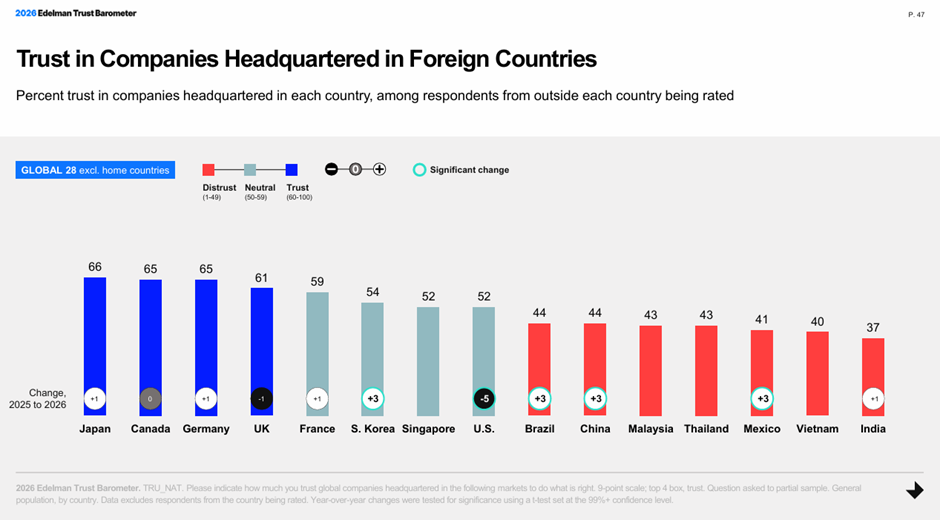
Source: Edelman Trust Barometer 2026
This means we are ranked higher than the United States, Brazil, and China, but we lose out to South Korea, the United Kingdom, and Japan. This is a unique position to start in, as just last year, the United States and South Korea were on opposite sides of where Singapore is today.
In fact, being headquartered in South Korea has seen a steady rise in trust, from a score of 43 in 2017 (considered distrusted) to 54 today. One could argue that this reflects both its technological leadership as the home to global giants like Samsung, Hyundai, and LG, and the meteoric rise of South Korean popular culture in the past decade, dubbed the second generation of the Korean Wave.
Being headquartered in China has also seen a steady rise in trust, from a score of 35 in 2017 to 44 today. While it has yet to move out of the “distrusted” range during this period, the rise suggests greater openness to Chinese brands globally. This could be based on the growing awareness of Chinese brands like Huawei and BYD, and of course Tiktok’s global popularity.
Read Also: From Ice Cream To Coffee: Why Chinese Brands Are Suddenly Everywhere In Singapore
Conversely, companies headquartered in the US have lost significant trust, especially over the past year. While their score never left neutral territory (50-59 points) during this time, it fluctuated from 55 in 2017 to 52 today. This latest score represents a drop of 5 points from 57 last year, the most of any country (any movement of more than 2 points is considered significant by Edelman). The last time the US brand suffered such a significant drop was in 2018, when it dropped from 55 in 2017 to 50 in 2018.
What Singapore Can Learn From Countries That Are Traditionally Trusted
The United Kingdom, Germany, Canada, and Japan have all traditionally scored relatively higher than other countries on the Edelman Trust Barometer, and this year’s results are no different.
The UK’s reputation as a global finance hub, with its deep capital markets, continues to give it international credibility, and post-Brexit challenges like supply chain disruptions and labour shortages have had a negative but ultimately small impact on trade and GDP.
Germany is one of the world’s largest economies and a hub for business in the European Union. Their engineering excellence, as well as their status as one of the largest exporters of high-end vehicles in the world, would add to this reputation.
Canada’s transparent governance and strong legal protections ensure its reputation as one of the least corrupt countries in the world. Its consistent focus on inclusivity and tolerance is reflected in direct economic benefits, both through its multicultural workforce and its ability to build resilient international partnerships.
Japan is globally recognised for quality manufacturing and technological innovation, enshrined by brands like Toyota and Sony. They have also developed a reputation for reliability and meticulous attention to detail. Japan’s legal system, especially with its intellectual property protections, also reinforces its image as a safe and principled place to do business.
Read Also: 7 Things That Make Singapore One Of The Easiest Places To Do Business
Subscribe To The DollarsAndSense Business Pass
Enjoy what you are reading and want more? Join The DollarsAndSense Business Pass and unlock access to valuable tools, exclusive networking opportunities, and tap into the wisdom of industry experts to fuel your business expansion!