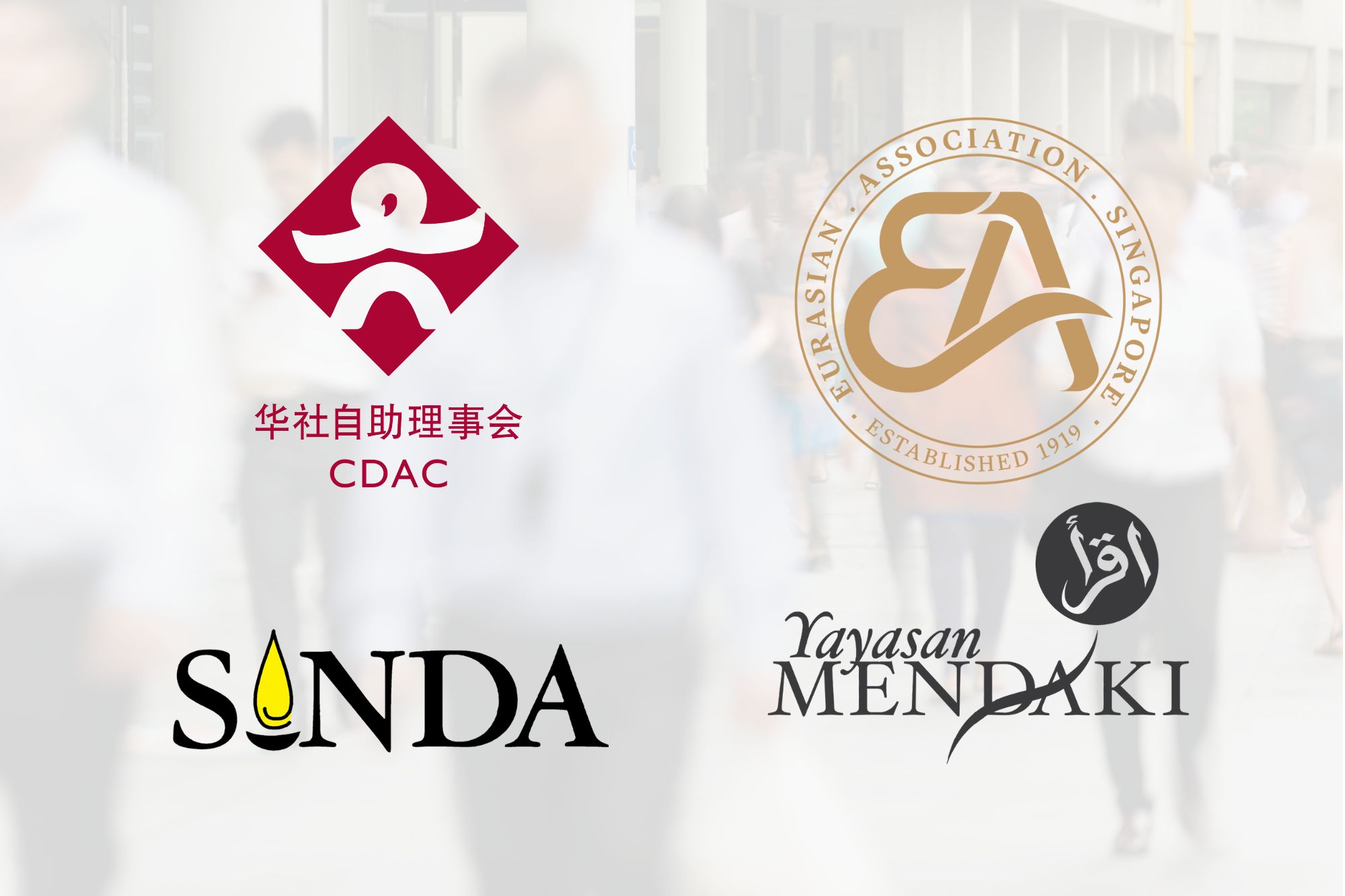
When employers make CPF contributions for their employees, they are required to make 3 types of payments: 1) both employer and employee CPF contributions, 2) Skills Development Levy (SDL), and 3) employee contributions to Self-Help Groups (SHGs).
While the employer and employee CPF contributions go into the employee’s CPF account, CPF only acts as the collection agent for the Skills Development Levy (SDL) on behalf of SkillsFuture Singapore (SSG) and contributions to Self-Help Groups (SHGs) – CDAC, ECF, MBMF or SINDA.
Contributions to Self-Help Groups are used to uplift the less privileged and low-income households in Singapore – particularly within each racial group. The government has also described how SHGs “play a critical and irreplaceable role in complementing the government’s efforts to enhance social mobility”.
Read Also: Complete Guide To Employer’s CPF Contributions In Singapore
What Are The Self-Help Groups (SHGs)?
The four Self-Help Groups (SHGs) are differentiated based on the main races in Singapore. While it may seem like each Self-Help Groups (SHGs) only support a single race, this may not always be the case. For example, Vibrance@Yishun Self-Help Groups Centre is a collaboration between all four SHGs, and organises programmes to serve all ethnic groups.
Membership is required to attend these programmes – open to applications from those who have a Gross monthly household income (MHI) not exceeding $3,300; or
Gross monthly per capita income (PCI) not exceeding $1,000.
#1 Chinese Development Assistance Council (CDAC)
The CDAC was jointly set up by the Singapore Chinese Chamber of Commerce and Industry (SCCCI) and the Singapore Federation of Chinese Clan Associations (SFCCA) in 1992. CDAC offers programmes and assistance schemes to help the less privileged in the community to maximise their potential and enable social mobility.
Address: CDAC Building, 65 Tanjong Katong Road, Singapore 436957
Website: http://www.cdac.org.sg/
#2 The Eurasian Association, Singapore (EA)
The Eurasian Community Fund is managed by the Eurasian Association (EA) – which can trace its roots back to 1918. The main objectives of the EA is to look after the interests of all Eurasians in Singapore and promote the economic, social, moral, physical and intellectual advancement of all Eurasian citizens and PRs.
Address: Eurasian Community House, 139 Ceylon Road, Singapore 429744
Website: http://www.eurasians.org.sg/
#3 Majlis Ugama Islam Singapura (MUIS)
Majlis Ugama Islam Singapura or MUIS manages the Mosque Building and Mendaki Fund (MBMF). As Singapore rapidly urbanised in the early 1970s, a Mosque Building Fund was introduced in 1975 to build mosques in new estates. With the establishment of the MENDAKI Foundation in 1984 to support educational and social programmes, the scheme was expanded into the Mosque Building and Mendaki Fund (MBMF). Since 2009, MBMF’s scope has included supporting mosque upgrading and religious education initiatives.
Address: Singapore Islamic Hub, 273 Braddell Road, Singapore 579702
Website: http://www.muis.gov.sg/
#4 Singapore Indian Development Association (SINDA)
Established in 1991, SINDA runs a wide array of programmes to uplift the socio-economic status and educational performance of the Indian community in Singapore.
Address: 1 Beatty Road, Singapore 209943
Website: http://www.sinda.org.sg
What Is SHARE Programme?
Apart from Self-Help Groups (SHGs), employees can also voluntarily donate to the Social Help and Assistance Raised by Employees (SHARE) through deductions from their wages. SHARE is a programme run by Community Chest to support many critical social service programmes.
Similar to contributions for SHGs, the CPF Board also collects donations for SHARE on behalf of the Community Chest, a division of the National Council of Social Service.
100% of donations to SHARE are channelled to support programmes for children with special needs and youths-at-risk, people with disability, persons with mental health conditions, seniors in need of support and families in need of assistance.
Address: Community Chest, National Council of Social Service (NCSS), Ulu Pandan Community Building, 170 Ghim Moh, #01-02, Singapore 279621
Website: www.comchest.sg
How Much To Contribute To The Self-Help Groups (SHG)?
Interestingly, employees have to contribute different amounts based on their salaries AND their race. Interns may be required to pay SHG contributions as well. You should check on the CPF website for more information.
Chinese Development Assistance Council (CDAC) Fund
Contributions for the CDAC Fund are collected from Chinese employees who are Singaporeans and PRs.
| Chinese Employees’ Monthly Total Wages | Monthly Contributions |
| $2,000 or less | $0.50 |
| Above $2,000 to $3,500 | $1.00 |
| Above $3,500 to $5,000 | $1.50 |
| Above $5,000 to $7,500 | $2.00 |
| Above $7,500 | $3.00 |
Eurasian Community Fund (ECF)
ECF contributions are collected from Eurasian employees who are Singaporeans and PRs. A “Eurasian” person is defined as such in his/her identity card or a person of both European and Asian ancestry.
| Eurasian Employees’ Monthly Total Wages | Monthly Contributions |
| $1,000 or less | $2.00 |
| Above $1,000 to $1,500 | $4.00 |
| Above $1,500 to $2,500 | $6.00 |
| Above $2,500 to $4,000 | $9.00 |
| Above $4,000 to $7,000 | $12.00 |
| Above $7,000 to $10,000 | $16.00 |
| Above $10,000 | $20.00 |
Mosque Building and Mendaki Fund (MBMF)
Managed by MUIS, or the Majlis Ugama Islam Singapura, MBMF contributions are collected from Muslim employees who are Singaporeans, PRs, and foreign employees on Employment Pass (EP) or Work Permits.
| Muslim Employees’ Monthly Total Wages | Monthly Contributions |
| $1,000 or less | $3.00 |
| Above $1,000 to $2,000 | $4.50 |
| Above $2,000 to $3,000 | $6.50 |
| Above $3,000 to $4,000 | $15.00 |
| Above $4,000 to $6,000 | $19.50 |
| Above $6,000 to $8,000 | $22.00 |
| Above $8,000 to $10,000 | $24.00 |
| Above $10,000 | $26.00 |
Singapore Indian Development Association (SINDA) Fund
SINDA receives SHG contributions from Indian employees who are Singaporeans, PRs and foreign employees on Employment Pass (EP). Indian employees include Bangladeshis, Bengalis, Parsees, Sikhs, Sinhalese, Telegus, Pakistanis, Sri Lankans, Goanese, Malayalees, Punjabis, Tamils, Gujaratis, Sindhis and all people originating from the Indian sub-continent.
| Indian Employees’ Monthly Total Wages | Monthly Contributions |
| $1,000 or less | $1.00 |
| Above $1,000 to $1,500 | $3.00 |
| Above $1,500 to $2,500 | $5.00 |
| Above $2,500 to $4,500 | $7.00 |
| Above $4,500 to $7,500 | $9.00 |
| Above $7,500 to $10,000 | $12.00 |
| Above $10,000 to $15,000 | $18.00 |
| Above $15,000 | $30.00 |
While these are the standard contribution amounts, your employees can contribute a different amount (more, less or nothing) to their respective Self-Help Groups (SHGs). They need to do so by obtaining the relevant forms from their respective SHG.
In multiracial Singapore, some of your employees may also have “double-barrelled” race, like Indian-Chinese. In such instances, employers are to take the first displayed race as their NRIC race to contributions to Self-Help Groups.
However, Muslim employees will need to contribute to Mosque Building and Mendaki Fund (MBMF) regardless of what their race states. For example, if a Muslim employee’s indicated race on their NRIC is Indian, they have to contribute to both MBMF and SINDA. If a Muslim employee’s race is indicated as Chinese-Indian, they have to contribute to both MBMF and CDAC.
While this is the default, employees retain the option to choose to contribute to either or both funds by contacting the relevant Self-Help Groups.
Read Also: Skills Development Levy: What Is It And How Much Do Companies Need To Pay?
How To Pay For Your Employees SHG Contributions?
Employers are expected to deduct the Self-Help Group (SHG) contributions from their employee’s wages, so as to make the payment when contributing to your employees’ CPF accounts.
Employers are required to request for their employee’s race/religion, so that the deductions are paid to the correct Self-Help Group (SHG).
You can treat such deductions in the same manner as employee CPF contributions that you deduct from their wages to contribute to their CPF account, before paying their salaries.
If your employee wants to stop contributing to their Self-Help Group, they need to contact their respective SHG to do so. Employers cannot simply stop making payment to the SHG on their behalf.
If you have made an incorrect contribution to an SHG, you have to contact the SHG directly. Details for the SHG contact is listed at the end of the article.
Subscribe To The DollarsAndSense Business Pass
Enjoy what you are reading and want more? Join The DollarsAndSense Business Pass and unlock access to valuable tools, exclusive networking opportunities, and tap into the wisdom of industry experts to fuel your business expansion!


