According to the statistics from the Law Ministry, a total of 77 companies have been wound up through compulsory liquidation in the first five months of this year. Fortunately, the number is still lower than the peak of 287 recorded for the whole of 2019. Nevertheless, businesses continue to face uncertainty and pressure amidst fast-rising inflation, high energy prices, and supply chain disruptions in the second half of the year.
Small and medium-sized enterprises (SMEs) are the backbone of Singapore’s economy. Based on the statistics from Singstat 2021, they represent 99% of the total 281,000 enterprises in Singapore and employ 70% of the population. Therefore, the liquidation (winding up) of these companies affects different stakeholders.
Companies Could File For Liquidation For Many Reasons
While there might be only a single reason to start a business, which is to generate a profit, there are many reasons why a company is wound up.
Some of the reasons why a business would file for liquidation could be that the owners have decided to cease their business operations, there is a breach of statutory provisions, or the company could be part of a corporate restructuring within a larger group of entities.
Read Also: When Do You Know It’s Time To Shut Down Your Unprofitable Business?
Once The Company Is Liquidated, It Will Cease To Exist
In a liquidation process, the company’s assets are seized and realised, which would then be used to pay off its debts and liabilities. Thereafter, the surplus is distributed to the shareholders of the company according to their rights and interests.
Once the liquidation is carried out, the company goes into dissolution and will cease to exist.
If The Company Is Solvent, Members’ Can Choose To Either Strike-Off Or Do A Voluntary Wind-Up
The director of a company can choose to strike the company’s name off the register with ACRA, if it is either a dormant company or has ceased its business activity. Additionally, the company should not have any outstanding debts owed to the IRAS, CPF, or other government agencies. It must also not have any existing assets or liabilities at the date of application or be involved in any legal proceedings.
A company can also be dissolved through a voluntary winding-up application filed by its members or shareholders. They must, however, ensure that the company is able to pay its debts in full within 12 months after commencing the winding up process. In addition, the company’s directors will be required to file a declaration of solvency.
Read Also: Guide To Closing Down A Company In Singapore: Striking Off Company & Winding Up
If The Company Is Insolvent, It Has Two Winding Up Options – Creditors’ Voluntary Winding Up And Compulsory Winding Up
A company is deemed unable to pay off its liabilities to its creditors under section 125(2)(a) of the Insolvency, Restructuring and Dissolution Act 2018 if it owes more than $15,000 and is unable to pay within 3 weeks upon being served with a demand.
In such an instance, the company can seek a meeting with its creditors and propose a voluntary winding up of the company. Hence, the term “creditors’ voluntary winding up.” If approved, the company has to appoint a liquidator, subject to the creditors’ preference.
Otherwise, the company might have to go through a compulsory winding up. Under section 124 of the Insolvency, Restructuring and Dissolution Act 2018, the company, its shareholders, the creditors, the liquidator, judicial manager or the Minister may present a compulsory winding up application to the High Court. Whichever party files the application has to pay a winding up deposit of $10,400 to the Official Receiver.
Insolvent Companies Could Also Be Placed Under Judicial Management Instead of Being Wound Up
A company could also be placed under judicial management if the company or its creditors deem that there is a reasonable probability of rehabilitation instead of winding it up.
In judicial management, the court can appoint an independent judicial manager under section 91 of the Insolvency, Restructuring and Dissolution Act 2018 to manage the affairs of the insolvent company. The company is also shielded from legal proceedings against it while it is given the opportunity to restructure and rehabilitate itself.
Read Also: A Second Chance: What Happens When Companies Like Naiise Make A Comeback?
The Appointed Liquidator Will Adjudicate The Claims Of The Creditors And Ensure A Fair Distribution Of The Company’s Assets
The appointed liquidator plays three key roles. First, is to investigate the affairs and assets of the company, the conduct of the company’s officers, and the claims of creditors and third parties. Second, to recover and realise the company’s assets in the most advantageous manner. Third, to adjudicate the claims of the creditors and ensure an equitable distribution of the company’s assets.
Some of the assets that the liquidator may realise include the cash in hand or held in other financial institutions; book debts disclosed in the Statement of Affairs; and sale of the office fittings and properties owned by the company.
The Company’s Assets Will Be First Distributed To Preferential Creditors, Then Ordinary Creditors Will Be Paid Pari Passu
The proceeds from the realised company’s assets will be paid to preferential creditors as set out in section 203 of the Insolvency, Restructuring and Dissolution Act 2018 in the following order:
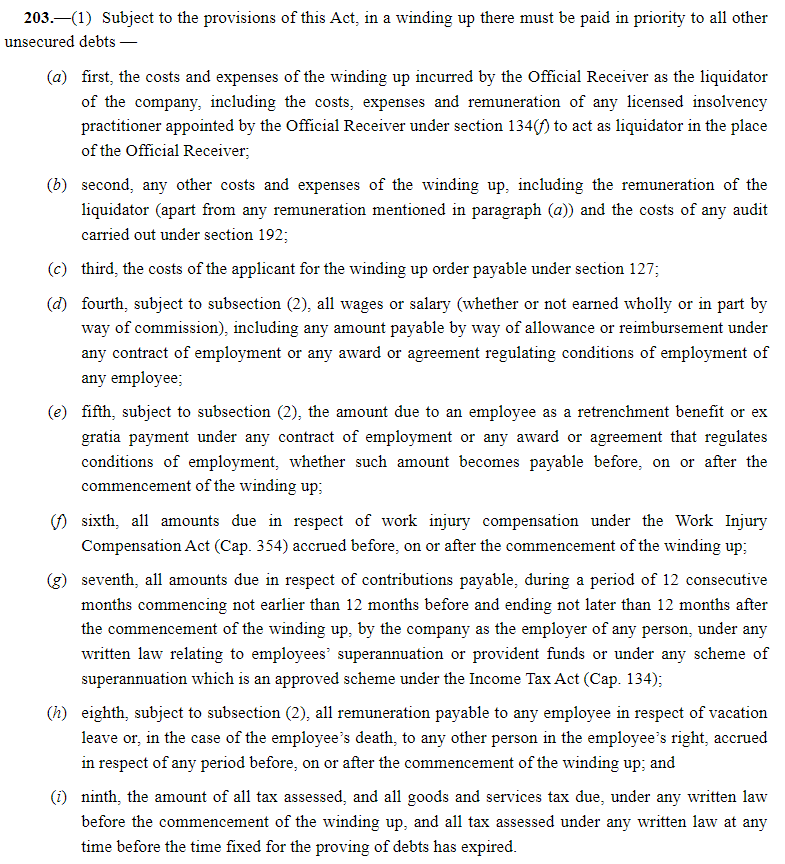
After the full payment of these preferential claims, the remaining amount will be paid pari passu (paid out equally) to all unsecured ordinary creditors.
Any remaining amount will then be given to the shareholders in proportion to their interests in the company’s share capital.
Subscribe To The DollarsAndSense Business Pass
Enjoy what you are reading and want more? Join The DollarsAndSense Business Pass and unlock access to valuable tools, exclusive networking opportunities, and tap into the wisdom of industry experts to fuel your business expansion!


