
Following the worst recession on record in 2020, the Singapore economy rebounded strongly in 2021 – expanding 7.6%. Despite having to manage ongoing COVID-19 safe management measures and supply chain disruptions, both companies and employees benefitted in 2021.
To find out more about how employees were paid in 2021, we looked at MOM’s recently released Report on Wage Practices 2021. Here are 5 things we learned.
#1 Over 75% Of Companies Were Profitable In 2021
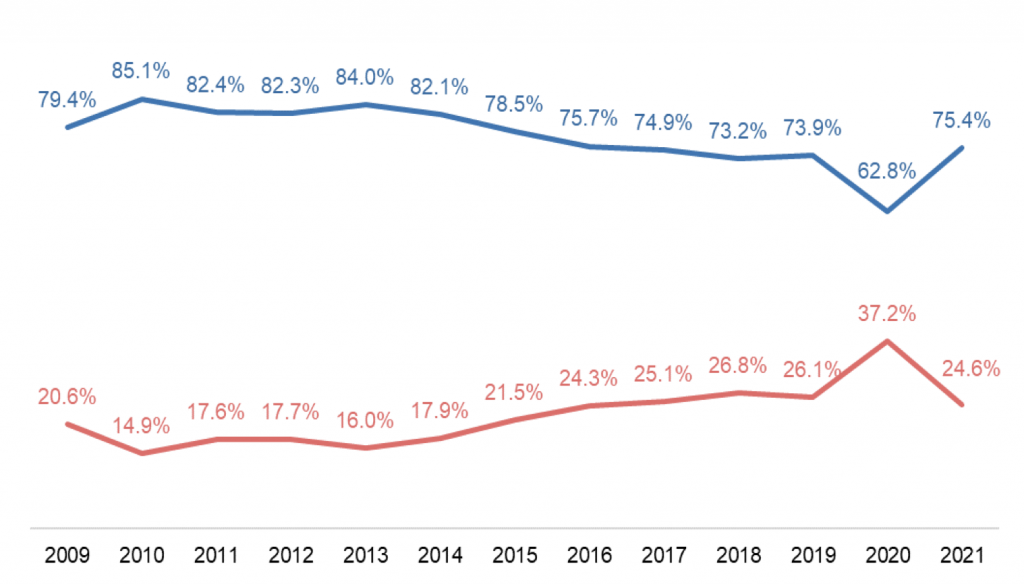
Over 75% of businesses reported that they were profitable during the year. This was a welcomed improvement from 2020, when just about 63% of companies in Singapore were profitable.
In fact, the number of profitable companies in 2021 was also higher compared to 2019 and 2018 – when there was no COVID-19 holding them back.
However, if we look at the statistics since 2010 to just before COVID-19 hit, we can see a general downward trend for companies reporting profits.
Read Also: Singapore Employers Are Hiring. But Where Exactly Are These Job Opportunities?
#2 Nominal Wages For Employees Rose 3.9%
On the back of more companies reporting profits in 2021, employees were rewarded with a 3.9% nominal wage growth during the year. This was far better than the 1.2% nominal wage growth employees got in 2020.
Nominal wage growth in 2021 was also close to the pre-pandemic wage growth figures – 3.9% in 2019, 4.6% in 2018 and 3.8% in 2017.
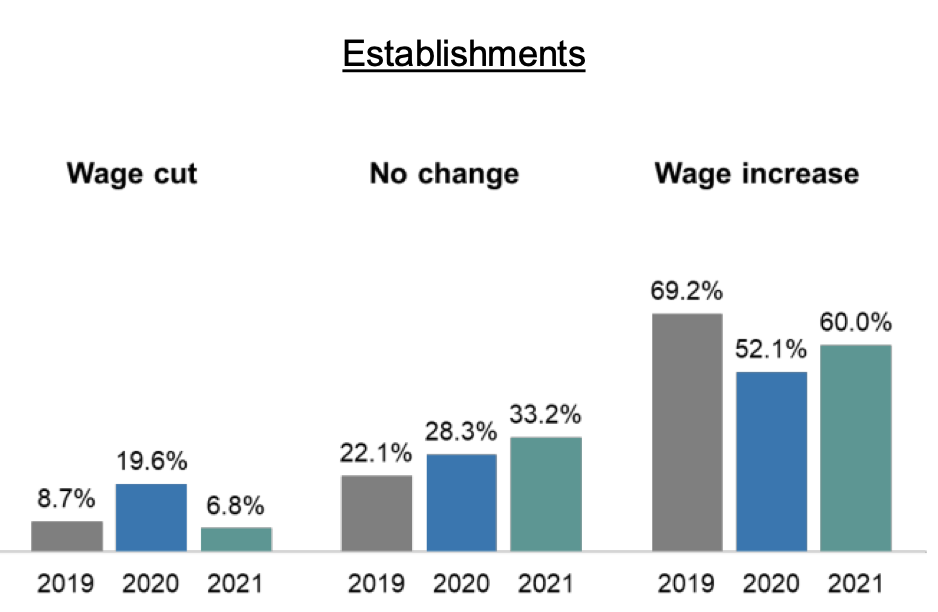
6 in 10 companies gave out wage increases in 2021, which is still shy of pre-pandemic figures. Nevertheless, this is heartening, especially when combined with the fact that fewer companies enforced wage cuts in 2021, even when compared to 2019.
#3 Real Wage Grew By A More Modest 1.6%
Despite a much better nominal wage growth for employees, real wages only grew by 1.6% in 2021. This is not very far off from the 1.4% increase in 2020. According to the MOM report, this can be attributed to rising prices.
Real wage growth post-COVID-19 paints a different story compared to pre-COVID-19. Real wages grew between 5.4% and 3.3% in the five years preceding 2020 – from 2015 to 2019.

The report does not talk about 2022. However, given the inflationary pressures we are facing, there’s a very real possibility that real wages will be even more suppressed in 2022.
#4 All Sectors Paid Out Higher Wages In 2021
Those who have been keeping up with the news would notice that certain sectors were able to manage COVID-19 and the overall downturn better than others. These include the Information and Communications and Financial Services sectors. Other sectors, such as Retail, Accommodation, Transportation and F&B Services typically fared the worst.
Despite this, all sectors were able to pay out higher wages in 2021.

#5 Bigger Companies Paid Higher Wages In 2021
What was also interesting in the report was that bigger companies were more likely to pay out higher wages in 2021. Companies with 10-24 employees saw their total wage growth increase 2.9%, while businesses with more employees generally saw a higher total wage growth.

Read Also: 4 Things We Learned About Employees In Singapore From The Labour Market 2021 Report
Total Wages Grew In 2021, But Will Employees In Singapore Continue To Benefit In 2022?
In general, employees saw their wages increase in 2021. This should not be the most surprising thing as the economy rebounded strongly in 2021, and other possible reasons include possible reinstatement of pay cuts or raises after a pay freeze in 2020.
Singapore has also been experiencing a shortage of employees as well. With a record number of job openings reported in 2021. This effectively meant that there were more than 2 jobs available for every unemployed person in Singapore. The tight labour market certainly played a role in increasing wages in 2021.
However, as we have already seen in one of the points above, real wages may not be increasing that quickly. In 2021, real wages only grew 1.6%. Real wages may be further squeezed in 2022 as inflation spikes within various sectors.
Inflation in 2022 will not just impact employees’ wages either, but may also decrease the profitability of businesses. Moreover, rising geopolitical tensions and higher interest rates may also have a bearing on revenue slowdown.
All this would have an impact on the ability of businesses to continue paying a higher wage. On employees’ end, a spike in inflation will also take a bite out of wages.
Read Also: Chicken Prices To Increase: 4 Types Of Businesses Affected By The Export Curbs
Subscribe To The DollarsAndSense Business Pass
Enjoy what you are reading and want more? Join The DollarsAndSense Business Pass and unlock access to valuable tools, exclusive networking opportunities, and tap into the wisdom of industry experts to fuel your business expansion!


