
Based on the latest 2023 figures, Singapore’s total birth count and total fertility rate stood at 33,541 and 0.97%, respectively. To boost these low numbers, the government has actively implemented various schemes to encourage couples to have more children.
The Government-Paid Maternity Leave (GPML) is one such scheme, where eligible mothers are given a period of maternity leave that is paid for by the government. The scheme was revised recently to benefit more working mothers and ease their burden of having children.
By paying for the maternity leaves, the government has also alleviated some of the burden on companies when their female employees have children. These measures help to protect female employees during their pregnancy period from unfair dismissal by companies looking to cut costs.
Therefore, it is important for both employees and the employers to know their entitlement benefits and not feel concerned by what should be a joyous occasion.
Read Also: 4 Types Of Government-Paid Schemes That Employers Also Have To Contribute To
#1 Who Is Eligible And What Are The Maternity Benefits?
In Singapore, there are two categories of employees who are entitled to maternity leave.
The first category of employees falls under the Child Development Co-Savings Act. This group is for mothers and where the child born is a Singapore citizen at birth or becomes a Singapore citizen within 12 months from the date of birth.
The other group is for mothers, and where their child is not a Singapore citizen, their entitlement to maternity benefits will fall under the Employment Act.
Read Also: Singapore Employment Act: 10 Statutory Requirements To Pay Employees
Maternity Leave: When The Child Is A Singapore Citizen
For the first group, where the child is a Singapore citizen and regardless of the nationality of the mother, she is entitled to 16 weeks of Government-Paid Maternity Leave (GPML).
This is provided she, as an employee, has worked with the employer for a continuous period of 3 months before the child’s birth or if she is a self-employed person, has engaged in her work for a continuous period of 3 months and has lost income during the maternity leave period.
Companies will also co-fund up to 8 weeks of maternity leave, if their employee is giving birth to their first or second child. For employees giving birth to their third and subsequent child, the full 16 weeks of maternity leave will be paid for by the government.
Read Also: Maternity Leave: Understanding The Rights Of A Pregnant Employee In Singapore
Maternity Leave: When The Child Is Not A Singapore Citizen
For the second group, where the child is not a Singapore citizen, the mother is only entitled to a minimum of 12 weeks of maternity leave as covered under the Employment Act.
The employer is only required to pay for the first 8 weeks of leave if the mother has fewer than two living children at the time of delivery, with the remaining 4 weeks of maternity leave to be taken as unpaid leave, depending on the employment contract. This also means that there is no government-paid component for maternity leaves for children who are not Singapore Citizens.
The above benefits are applicable only if the working mother is covered by the Employment Act and has served under the employer for a continuous period of at least 3 months prior to the child’s birth.
Read Also: Minimum Requirements For Key Employment Terms (KETs) On Employees Contracts
#2 When Can You Take Your Maternity Leave
Eligible mothers may begin their first 8 weeks of continuous maternity leave as early as 28 days before the child’s due date of birth or no later than the day of the child’s birth as mutually agreed between the employer and employee.
The remaining 4 or 8 weeks of maternity leave, depending on which category the mother falls under, must be cleared no later than 12 months from the child’s date of birth.
The remaining leave can be taken as a continuous block immediately after the first 8 weeks or can be taken non-continuously as agreed between employer and employee. This provides greater flexibility for mothers to return to their jobs, and work with their employers to continue using maternity leaves to care for their child afterwards.
#3 How Are Maternity Leaves Calculated?
Maternity leave, when taken in a block period, includes all non-working days, public holidays and sick leave.
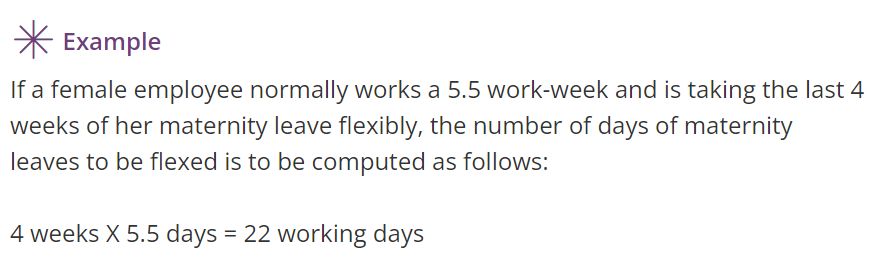
However, should a female employee decide to consume her maternity leave flexibly, then the number of days she would be entitled to would be equal to the number of working days she would be away if she used and consumed it in a block.
For better clarity, you may refer to the example cited below.
Read Also: How Much Employers Have To Pay Employees For Working On A Public Holiday?
#4 When Can An Employer Refuse To Grant Maternity Benefits?
It is an offense for an employer to refuse to grant maternity leave to a female employee who is eligible for it. And employees who are wronged can seek assistance from the Tripartite Alliance for Dispute Management (TADM).
However, if the female employee has not given sufficient notice of at least one week as required before going on maternity leave, then the employer has the right to pay only half of the payment during maternity leave.
Read Also: Pay Disputes & Salary Matters: What Happens When A Working Relationship Turns Sour
Dismissal
According to section 81 of the Employment Act, it is an offense for an employer to give notice of dismissal when a female employee is on maternity leave.
Furthermore, section 84 of the same Act states a female employee is given maternity protection and is entitled to maternity benefits if she were to be dismissed without sufficient cause within 6 months before her confinement period, provided she has worked for 3 continuous months.
Retrenchment
According to section 84A, if the female employee were to be dismissed on the grounds of redundancy within 3 months of her confinement period, she would be entitled to the full maternity benefits.
Change Of Jobs
Any female employee switching jobs will not be able to transfer any unused maternity leave to the new company as the unused maternity leave from her previous employment will be forfeited.
Additionally, the female employee cannot use the maternity leave to shorten her notice period, though she is allowed to use her maternity leave during the notice period.
#5 How Much Can Companies Claim Towards The Maternity Benefits?
Companies can claim from the government for the extended maternity leave granted to a female employee under the Government-Paid Maternity Leave (GPML) scheme.
The employer must pay for the first 8 weeks of maternity leave, if it is either the female employee’s first or second child.
However, for the remaining 8 weeks of maternity leave, the company can claim back from the government at a rate capped at $10,000 per 4 weeks or $20,000 per child.
For the third and sequent child of the female employee, the company can claim back all 16 weeks of maternity leave at the same capped rate of $10,000 per 4 weeks or $40,000 per child.
| Births | Maternity Paid By Employer | Maternity Paid By Government |
| First and Second | 8 weeks | 8 weeks |
| Third and subsequent | – | 16 weeks |
#6 What If An Employee Is Working For Different Employers?
If the female employee is employed by more than one company simultaneously before her date of delivery, she can claim her maternity benefits from her multiple employers.
However, she is not allowed to work for another employer during her maternity leave. If she does so, the female employee’s entitlement to maternity benefits will be forfeited and is a ground for dismissal.
#7 Are Short-Term Contract Employees Entitled To Maternity Leave
Eligible working mothers who might be on short-term employment contracts such as gig economy workers or employment contracts that have expired before the birth of their child and have worked at least 90 days in the last 12 months can claim cash benefits of up to $40,000 per child under the Government-Paid Maternity Benefit (GPMB) scheme, in lieu of the leave that they would have otherwise received under the GPML.
The government will pay for 56 days of the working mother’s income at a rate capped at $10,000 per 28 days for the first and second child.
And for the third and subsequent child, the government will pay for 112 days of the working mother’s income based on the same capped rate.
For more details on how the cash benefit is calculated, you may refer to the breakdown below.

#8 Do Dads Get Maternity Benefits?
Dads get paternity leave. Working dads are given two weeks of paternity leave that can be taken within 12 months from the child’s date of birth.
Moreover, a working mother can share a minimum of one week and up to four weeks of her maternity leave with the working father from the date of the child’s birth under the Government-Paid Shared Parental Leave (SPL) scheme.
The father, who must be legally married to the working mother, can consume his entitled leave either in one continuous block or take it flexibly as agreed between the employer and employee.
The government will reimburse the leave taken at the same capped rate as accorded to the working mother or up to $ 2,500 per week.
#9 Do These Benefits Apply If An Employee Adopts A Newborn Child?
The eligible adoptive mother is entitled to 12 weeks of paid adoption leave at a capped rate of $10,000 per 4-weeks of leave taken, provided either the child is a Singapore citizen below the age of 12 months or if it’s a foreign child, then one of the adoptive parents must be a Singapore citizen and the child must become a Singapore citizen within 6 months of the adoption.
The adoption leave must be consumed within the child’s first birthday.
#10 How Much Can Companies Claim For Adoption Leave Taken By An Employee?
Companies must pay for the first 4 weeks of the female employee’s salary if it’s her first and second child. The company can claim remaining 8 weeks of leave that the employee is entitled subjected to a maximum claim of $ 20,000 per child. For the third and subsequent child, companies can claim the full 12 weeks of adoption leave that the female employee is entitled to at a capped of $30,000 per child.
This article was first published on 21 February 2022 and has been updated with the latest information.
Subscribe To The DollarsAndSense Business Pass
Enjoy what you are reading and want more? Join The DollarsAndSense Business Pass and unlock access to valuable tools, exclusive networking opportunities, and tap into the wisdom of industry experts to fuel your business expansion!


