Most of us think about notice periods only when it comes time to resign from a job. Yet, notice periods are more than just a formality—they are a key part of the employment contract that protects both employers and employees.
In Singapore, a termination letter can be served by either side. Once the letter is acknowledged by both parties, the notice period in the contract comes into effect.
But who really benefits from a longer notice period? Is it the employer or the employee?
What Is A Notice Period & Why Do We Have One?
A notice period is the agreed time frame between when one party gives notice of termination and the actual end of employment. In Singapore, the length of this period is typically stated in the employment contract, and this is something that can (sometimes) be negotiated between both employers and employees prior to the signing of the employment contract.
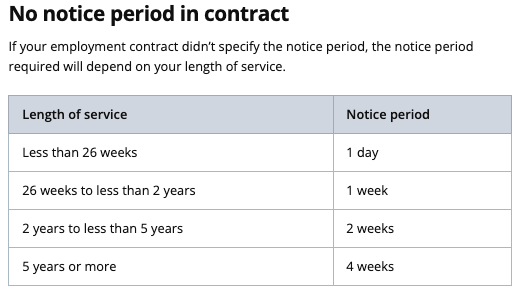
In the event that there is no notice period stated in the employment contract, the Employment Act also sets out minimum notice periods depending on how long an employee has worked for a company.
The purpose is practical. Employers need time to find and train a replacement when there is a staff who is leaving, while employees who are asked to leave may use the period to wrap up ongoing projects and to hand over responsibilities. Most importantly, they can also find a job during this period.
What Happens If You Refuse To Serve Your Notice?
Refusing to serve the notice period stated in your contract can have consequences for both parties. The most common arrangement is for the employee to pay salary in lieu of notice. For example, if your notice period is one month and your monthly pay is $4,000, leaving without serving notice usually means compensating your employer with one month’s salary.
At the same time, an employer who ends employment without giving notice must also compensate the employee accordingly. Thus, notice periods are not one-sided and they bind both parties.
In some cases, both the employer and the employee may agree to waive the notice period. This usually happens if both parties mutually agree that there is little benefit in continuing the working relationship. For example, if an employee has no active projects left or if the employer wants a quick transition, they may mutually agree to shorten or skip the notice period. In this case, no compensation in lieu of the notice period is required since both parties mutually agree with the decision.
Why Longer Notice Periods Favour Employers
Generally speaking, longer notice periods tend to favour employers far more than employees. On paper, it may look balanced since the same terms bind both sides. In reality, the impact is felt very differently.
For employers, a longer notice period provides more time to recruit and train a replacement. This is especially critical in specialised roles or positions where client relationships are at stake. A three-month handover gives companies a safety net to ensure continuity, minimise disruption, and protect revenue streams. The organisation also retains control during this time, often redirecting an outgoing employee to knowledge transfer or administrative tasks that serve the company’s needs.
For employees, however, the same arrangement can quickly work against them.
A three-month notice period effectively “locks” someone in after they have already decided to leave. While longer notice periods may be reasonable for senior positions, some companies apply them even to entry-level roles, which can feel more like a way to handcuff staff than to serve a genuine business need. If a new employer wants someone to start quickly, especially for a junior position, they are unlikely to wait three months. This puts employees, especially those who are in a junior position, at a disadvantage, forcing them to forgo opportunities, accept weaker bargaining positions, and ultimately limit their career mobility.
In practice, the symmetry of “both parties must serve notice” is also misleading.
An employer who wants to terminate staff can usually afford to pay salary in lieu of notice, effectively buying their way out of the obligation. For an employee, however, leaving early means compensating the company with their entire notice period salary, which is often financially unfeasible at an individual level. The imbalance means that while employers can exit the arrangement relatively easily, employees are far more constrained.
When Longer Notice Periods Can Help Employees
However, longer notice periods can benefit employers. If an employee is retrenched or asked to leave, a longer notice period gives more financial stability while they search for a new job. For instance, a senior employee with a three-month notice period effectively has three more months of salary to tide them over, compared to someone on a one-month period.
Employees in senior roles may also prefer more extended notice periods because they provide assurance that their employer cannot terminate them abruptly without compensation.
The Bottom Line: Longer Notice Periods May Not Always Be As Fair As They Look
At first glance, notice periods seem like a balanced safeguard, applying equally to both employers and employees. But in practice, we think longer notice periods tilt heavily in favour of employers. Companies gain valuable time to protect operations and secure replacements. At the same time, employees face the real risk of missing out on job opportunities, losing flexibility, and being tied to a role they no longer want.
For employees, the promise of “security” from a more extended notice period often comes at a cost. If you are retrenched, the financial buffer may help, but such cases are less common than situations where employees want to resign to move on to another job.
Ultimately, when negotiating an employment contract, employees should carefully consider the trade-off. A long notice period may feel like a formality at the start of a job, but it can have significant implications later. Employers will almost always prefer longer notice periods for business continuity. For employees, the fairer approach may be to align notice periods with seniority and responsibilities, ensuring protection without being unnecessarily restrictive.
Read Also: Managing Notice Period: Understanding Employee Entitlements When They Are Leaving Your Business
Subscribe To The DollarsAndSense Business Pass
Enjoy what you are reading and want more? Join The DollarsAndSense Business Pass and unlock access to valuable tools, exclusive networking opportunities, and tap into the wisdom of industry experts to fuel your business expansion!


