In Singapore, foreign workers make up a significant proportion of our population. According to the latest data from June 2025, about 80% of the 1.91 million non-residents are Employment Pass (EP) holders, S-Pass holders, Work Permit holders and migrant domestic workers.
For EP and S-Pass holders, there are minimum qualifying salaries set by the Ministry of Manpower. For EPs, it is $5,600 per month (and $6,200 for the finance sector), and for S Pass holders, it is $3,300 per month (and $3,800). Both these minimum qualifying salaries increase with age. At the top-end, EPs and S-Pass holders aged 45 and above have a minimum qualifying salary of $10,700 and $4,650, respectively.
Based on the latest government figures, the median fixed monthly salary of EP holders was $9,500 in June 2023, while S-Pass holders earned a median fixed monthly salary of $3,296.
Read Also: Guide To Work Passes In Singapore: Work Permits, S Pass and Employment Pass (EP)
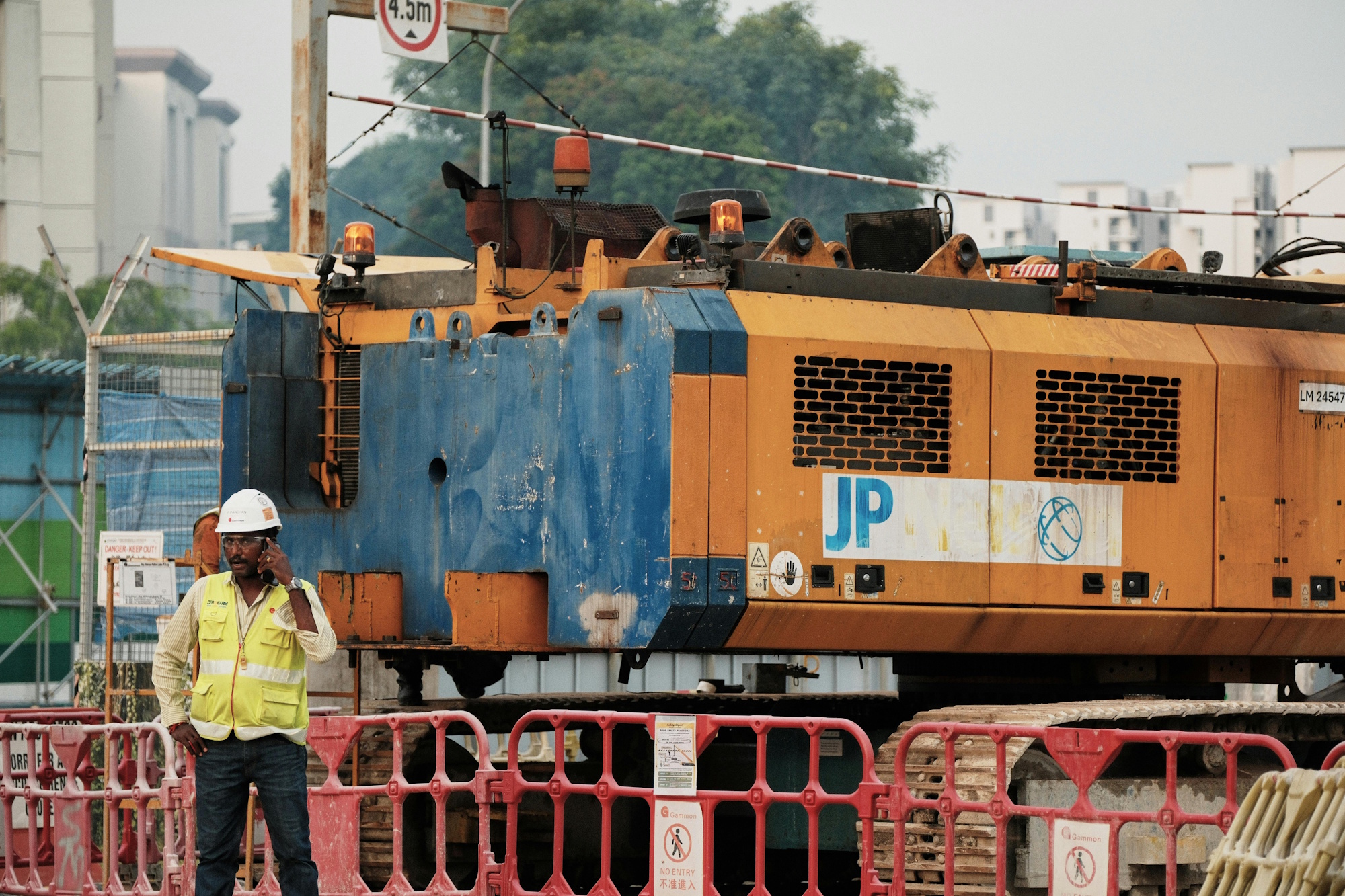
The largest proportion of foreign workers in Singapore are the work permit holders. There are nearly 1.2 million work permit holders in Singapore today, with over 460,000 in the construction, marine shipyard and process (CMP) sectors.
Unlike EP and S-Pass holders, there are no legally mandated minimum salaries for Work Permit holders. In the construction industry, workers may earn an average of $25 to $50 a day. This means construction workers in Singapore can earn more than $600 to $1,250 a month in fixed monthly wages. Construction workers qualify for overtime pay, which is mandated at 1.5 times their hourly rate.
Companies can also convert their workers to higher skilled workers to pay a lower monthly foreign worker levy. For example, one of the ways for a construction worker to be classified as a higher-skilled worker is if they earn a minimum fixed monthly salary of $1,600 or have worked for more than 4 years in the sector. In the construction sector, at least 10% of work permit holders must be higher-skilled workers.
However, companies in Singapore are expected to pay much more than just the wages of foreign workers. Additional costs borne by the company include accommodation, transport, medical insurance, and the foreign worker levy, which can often be higher than the wages.
Foreign Worker Levy
The foreign worker levy is a tax that regulates the number of foreign workers in Singapore. It complements the dependency ratio ceiling, or quota, which serves the same purpose. Foreign worker levies are paid monthly and differs from industry to industry.
Foreign Worker Levies For The Construction Industry
For the construction industry, the levy amount is based on the Work Permit holder’s skill level and their country of origin. India, Sri Lanka, Bangladesh, Thailand, Myanmar, and the Philippines are considered “Non-Traditional Sources”. Since 1 June 2025, this category also includes Bhutan, Cambodia, and Laos.
Hong Kong, Macau, South Korea and Taiwan are collectively referred as North Asian Sources. The levy for construction workers from these four locations is the same as the levy for those from Malaysia and the People’s Republic of China.
| Country Of Origin | Levy (Basic-Skilled) | Levy (Higher-Skilled) |
| Non-Traditional Sources | $900 | $500 |
| Malaysia, People’s Republic of China, North Asian Sources | $700 | $300 |
The levy for off-site construction workers is $370 for a basic-skilled worker and $250 for a higher-skilled worker, regardless of country of origin.
Some construction companies may also be required to pay a levy bond for each Work Permit holder, if they are a new business entity, are a sole proprietorship that has changed owner, or have been late in levy payments in the past.
The levy bond is $600 for a higher-skilled or basic-skilled worker, and $2,000 for an unskilled worker.
Read Also: 6 Differences In Work Permit Requirements Between Malaysians And Non-Malaysians Working In Singapore
Foreign Worker Levy For The Process Sector
The process sector includes plants in the manufacturing of petroleum, petrochemicals, specialty chemicals and pharmaceutical products.
Like the construction industry, the levy amount for the process sector is based on the Work Permit holder’s skill level and their country of origin. India, Sri Lanka, Bangladesh, Thailand, Myanmar, and the Philippines are considered “Non-Traditional Sources”. Since 1 June 2025, this category also includes Bhutan, Cambodia, and Laos.
Hong Kong, Macau, South Korea and Taiwan are collectively referred as North Asian Sources. The levy for process sector workers from these four locations is the same as the levy for those from Malaysia and the People’s Republic of China.
| Country Of Origin | Levy (Basic-Skilled) | Levy (Higher-Skilled) |
| Non-Traditional Sources | $650 | $300 |
| Malaysia, People’s Republic of China, North Asian Sources | $450 | $200 |
Foreign Worker Levies For The Manufacturing Industry
For the manufacturing industry, the levy amount is based on the skill level as well as the proportion of Work Permit holders in the company. The closer to the maximum quota, the higher the levy per Work Permit holder.
| Quota | Levy (Basic-Skilled) | Levy (Higher-Skilled) |
| Up to 25% of the total workforce | $370 | $250 |
| Above 25% and up to 50% of the total workforce | $470 | $350 |
| Above 50% and up to 60% of the total workforce | $650 | $550 |
Manufacturing companies can pay the higher-skilled levy amount (which costs less) under the Market-Based Recognition Framework, if the Work Permit holder is earning a fixed monthly salary of at least $1,600 and has worked at least 4 years in Singapore as a Work Permit holder.
Read Also: Complete Guide To Foreign Worker Quota In Singapore: Eligibility And How To Calculate
Foreign Worker Levy For The Marine Shipyard Industry
For the marine shipyard industry, the levy amount is simply based on skill level.
| Levy (Basic-Skilled) | Levy (Higher-Skilled) | |
| Marine Shipyard Industry | $400 | $300 |
From 1 January 2026, these amounts will increase to $500 for basic-skilled workers and $350 for higher-skilled workers.
Foreign Worker Levy For The Services Industry
Like the manufacturing industry, the levy amount for the services industry is based on the skill level as well as the proportion of Work Permit holders in the company. The closer to the maximum quota, the higher the levy per Work Permit holder.
| Quota | Levy (Basic-Skilled) | Levy (Higher-Skilled) |
| Up to 10% of the total workforce | $450 | $300 |
| Above 10% and up to 25% of the total workforce | $600 | $400 |
| Above 50% and up to 60% of the total workforce | $800 | $600 |
Companies in the services industry can pay the higher-skilled levy amount (which costs less) under the Market-Based Recognition Framework if the Work Permit holder is earning a fixed monthly salary of at least $1,600 and has worked at least 4 years in Singapore as a Work Permit holder.
Additional Costs Incurred By Companies When Hiring Foreign Workers
In addition to the foreign worker levy, companies that hire Work Permit holders are also responsible for their accommodations. Median monthly dormitory rental rates have increased sharply following the pandemic, from $280 to $420 per bed per month. Some employers reportedly spend more $600 per worker per month on dormitory costs.
Subscribe To The DollarsAndSense Business Pass
Enjoy what you are reading and want more? Join The DollarsAndSense Business Pass and unlock access to valuable tools, exclusive networking opportunities, and tap into the wisdom of industry experts to fuel your business expansion!


