For global markets, the past few weeks have been eventful. And, by that, we mean they’ve crashed nearly 20%, global heads of state have issued cautionary statements, and markets have recovered about half the initial drop.
All this has mainly been down to President Trump’s announcement of tariffs on nearly all countries in the world.
While stock markets fell sharply, the real fear for many countries is the potential for slower economic performance, or even a recession. Singapore’s economy, which has always been open and trade-dependent, may be even more vulnerable.
Against the backdrop of a looming global trade war, Singapore’s Ministry of Trade and Industry (MTI) recently downgraded its gross domestic product (GDP) growth projections for the local economy in 2025 to 0% to 2%, from a previous range of 1% to 3%.
But what does it actually mean for Singapore’s GDP growth forecasts to be revised down? Let’s dig in and find out.
Cautious Growth Projection For 2025, Slowing Q1 2025 Growth
On Monday 14 April, the MTI downgraded its GDP growth forecast for the Singapore economy and specifically cited the impact of US President Trump’s tariff roll-out, which will hinder global trade.
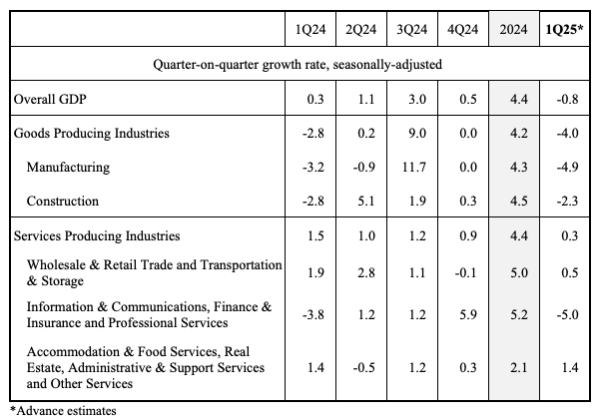
This forecast was released at the same time as Q1 2025 GDP growth figures. Singapore’s economy ended up growing 3.8% year-on-year in the first quarter of 2025, much slower than the 5% year-on-year growth recorded in Q4 2025, according to advanced estimates.
That 3.8% number also came in below economists’ consensus expectations for 4.5% year-on-year growth for the Singapore economy during the quarter.
As the number implies, GDP growth actually contracted quarter-on-quarter, falling by 0.8% on a seasonally-adjusted quarterly basis. MTI attributed this slowdown to sequential declines in manufacturing and finance/insurance as well as slowing external demand.
Read Also: Trump Tariffs: 4 Sectors With The Biggest Losses On The STI
Gross Domestic Product (GDP) in chained (2015) dollars
Recession On The Horizon?
By revising down its growth forecasts for the Singapore economy in 2025, the MTI is perhaps also setting expectations for investors and individuals alike.
That means this revision downwards could be a sign that the authorities in Singapore see a possible “technical recession” hitting the Singapore economy in 2025. What is a technical recession? A technical recession is the term used to indicate two consecutive quarter-on-quarter contractions in GDP.
As Singapore has already experienced a first quarter of negative GDP growth (Q1 2025), many analysts foresee a possible technical recession with slowing growth continuing in Q2 2025.
Of course, a 90-day tariff pause announced by President Trump could offer some reprieve for the Singapore economy but it’s still too early to tell for certain whether that will mean the Little Red Dot can avoid a recession.
Measures To Help Businesses But Slower Growth Ahead
Last week, Prime Minister Lawrence Wong announced that a taskforce would be set up to help support businesses and workers – in direct response to the new US tariffs. He said that the taskforce will help businesses and workers address immediate uncertainties, strengthen resilience and adapt to a new economic landscape.
PM Wong also later commented that Singapore “may or may not” slip into recession this year but recognises that the local economy will be significantly impacted.
As with any possible recession or slowdown, the fallout will be felt by individuals in the form of fewer job opportunities and smaller wage increases for workers – something PM Wong highlighted when he addressed parliament last week.
Furthermore, any multinational companies that either hold back on investing or move operations out of Singapore could result in higher retrenchments and job losses than normal. That is what typically occurs when a recession hits an economy.
Read Also: 5 Takeaways From PM Lawrence Wong’s Ministerial Statement About The Trump Tariffs
Uncertainty Reigns
As the events of the last two weeks have proven, uncertainty has reigned supreme. Unfortunately for businesses and individuals alike, uncertainty also means that investment is held back and growth is hindered.
With no clarity on global trade and the economy, both companies and consumers will tighten their belts and spend/invest less.
Fears of recession could, therefore, become a self-fulfilling prophecy as global economies spend and invest less, uncertain of how the unfolding trade tensions play out. For Singapore’s economy, the lower GDP growth projection from MTI is a sign that the global economic outlook is worsening and may take some time to stabilise.
Read Also: Donald Trump Tariffs: How Could Singapore’s Economy & Businesses Be Affected?
Subscribe To The DollarsAndSense Business Pass
Enjoy what you are reading and want more? Join The DollarsAndSense Business Pass and unlock access to valuable tools, exclusive networking opportunities, and tap into the wisdom of industry experts to fuel your business expansion!