As part of its commitment to the Paris Agreement, Singapore has set ambitious climate goals, with a key target of achieving net-zero carbon emissions by 2050. One significant step toward this objective was the introduction of a carbon tax in January 2019.
A carbon tax is a levy placed on the carbon content of fossil fuels such as coal, oil, and natural gas. This tax aims to incentivise businesses to reduce their greenhouse gas emissions by making the use of fossil fuels, which contribute to global warming, more costly.
The fundamental principle behind a carbon tax is to assign a financial cost to carbon emissions. By doing so, it encourages companies and industries to seek out cleaner and more sustainable energy sources. The higher cost of fossil fuel-based energy drives the pursuit of innovative solutions to lower carbon footprints and transition towards greener alternatives.
How Much Is The Carbon Tax In Singapore?
When the carbon tax was first implemented on 1 January 2019, it was set at $5 per tonne of greenhouse gas emissions (S$5/tCO2e) for five years, covering 2019 to 2023. This gradual introduction allowed businesses time to adjust to the new policy.
From 2024 to 2025, the carbon tax rate has significantly increased to $25 per tonne. The government has planned further increments, with the tax rising to $45 per tonne in 2026 and 2027. By 2030, the carbon tax is expected to range between $50 and $80 per tonne, aligning with Singapore’s long-term strategy to reduce carbon emissions and meet its climate goals progressively.
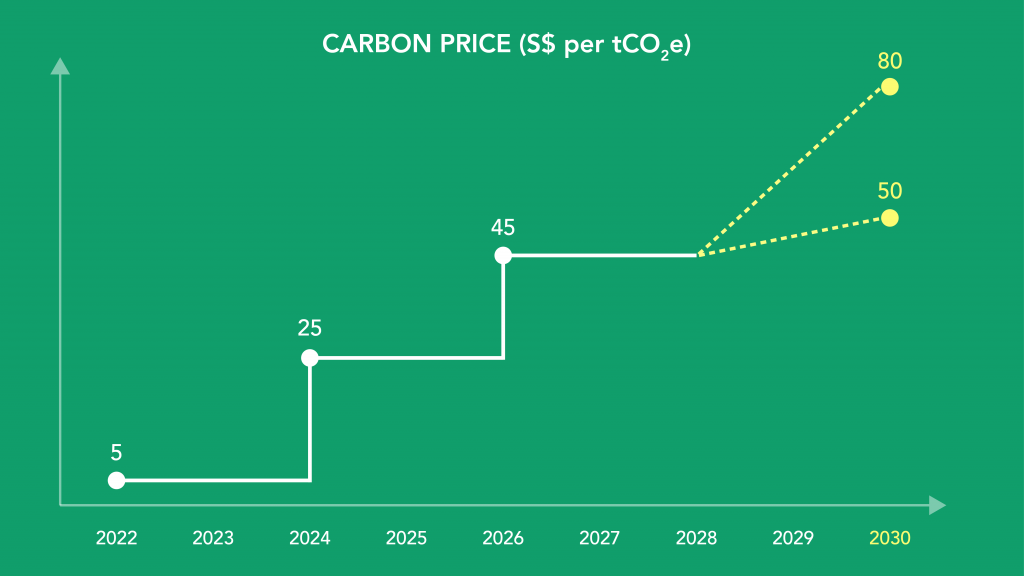
Image Source: National Climate Change Secretariat (NCCS)
According to the government, the revenue generated from the carbon tax is being used to support decarbonisation efforts, facilitate the transition to a green economy, and mitigate the impact on both businesses and households.
It has also been stated that the government does not expect to generate additional revenue from the carbon tax increase during this decade, as the focus remains on driving sustainable practices.
Who Pays The Carbon Tax?
The carbon tax is levied on facilities that emit at least 25,000 tCO2e of greenhouse gas (GHG) emissions annually. It currently covers seven GHGs, namely carbon dioxide (CO2), methane (CH4), nitrous oxide (N2O), hydrofluorocarbons (HFCs), perfluorocarbons (PFCs), sulphur hexafluoride (SF6), and Nitrogen Trifluoride (NF3).
According to NCCS, the carbon tax covers around 80% of our GHG emissions from around 50 manufacturing, power, waste and water facilities.
However, this doesn’t mean only these 50 facilities will pay the carbon tax.
Facilities in other sectors will also indirectly face a carbon price on the electricity they consume. Power generation companies are expected to pass on some of their tax burden through increased electricity tariffs.
Similarly, while consumers are not taxed directly, the carbon tax levied on large emitters could flow through in the form of higher electricity tariffs as power companies pass on the carbon tax to end users. On average, with every $5/tCO2e increase in the carbon tax level, electricity tariffs could rise by 1%. The increase in carbon tax to $25/tCO2e is estimated to translate to an increase of about $4 per month in household utility bills for the average 4-room HDB flat.
Use Of International Carbon Credits To Offset Taxable Emissions
Carbon credits permit companies to emit a specific amount of carbon dioxide or other greenhouse gases. Typically, one carbon credit represents the right to emit one metric ton of CO₂.
These credits are part of a cap-and-trade system, which enables companies to buy, sell, or trade them. If a company reduces its emissions below the allocated allowance, it can sell its excess credits to other companies. This creates a financial incentive for businesses to lower their emissions, while still operating within an overall emissions limit set by regulatory bodies.
Starting in 2024, companies will be allowed to use high-quality international carbon credits (ICCs) to offset up to 5% of their taxable emissions in Singapore.
This 5% cap ensures that industries remain focused on reducing domestic emissions while offering an alternative decarbonisation pathway for sectors where it may be difficult to achieve significant emission cuts in the near or medium term. This balance supports the transition to a lower-carbon economy while recognising hard-to-abate sectors’ challenges.
Subscribe To The DollarsAndSense Business Pass
Enjoy what you are reading and want more? Join The DollarsAndSense Business Pass and unlock access to valuable tools, exclusive networking opportunities, and tap into the wisdom of industry experts to fuel your business expansion!


