
Hospitalisation leave in Singapore is a crucial aspect of the nation’s employee protection system, designed to support individuals who are unable to work due to serious medical conditions requiring hospital care.
This provision ensures that workers recover adequately without the added stress of job insecurity or financial strain – in their most vulnerable moments.
Singapore’s hospitalisation leave policies play a vital role in promoting a healthy and productive workforce by offering comprehensive protection and support.
Hospitalisation Leave Includes MC
Under the Employment Act, employees are entitled to 60 days of paid hospitalisation leave.
What some may not immediately realise is that hospitalisation leave includes medical leave. In other words, if an employee has already taken 14 days of medical leave within the year, they are only entitled to 46 days of paid hospitalisation leave for the remainder of the year.
Read Also: 7 Things To Note About Getting Medical Certificates For Sick Leave In Singapore
Hospitalisation Leave Have Restricted Uses
While Medical Leave taken is deducted from the number of Hospitalisation Leave that can be taken, Hospitalisation Leave is not the same as Medical Leave and can only be taken under restricted circumstances. Hospitalisation Leave is intended to cover the period that a hospital doctor deems that an employee requires hospital care, and this covers the period where the employee is warded, or underwent day surgery, or when the employee is not warded but requires bed rest or further medical treatment after being discharged from hospital.
To qualify for paid Hospitalisation Leave, an employee must be warded in the hospital as an in-patient, go in for day surgery, be quarantined under any written law, or be certified by an approved medical practitioner.
It should be noted that while some cosmetic procedures require surgery, employers are not required to grant Hospitalisation Leave for cosmetic procedures.
Read Also: Who Should Pay For The Medical Leave If Your Employee Work Two Jobs?
Hospitalisation Leave Can Be Prorated
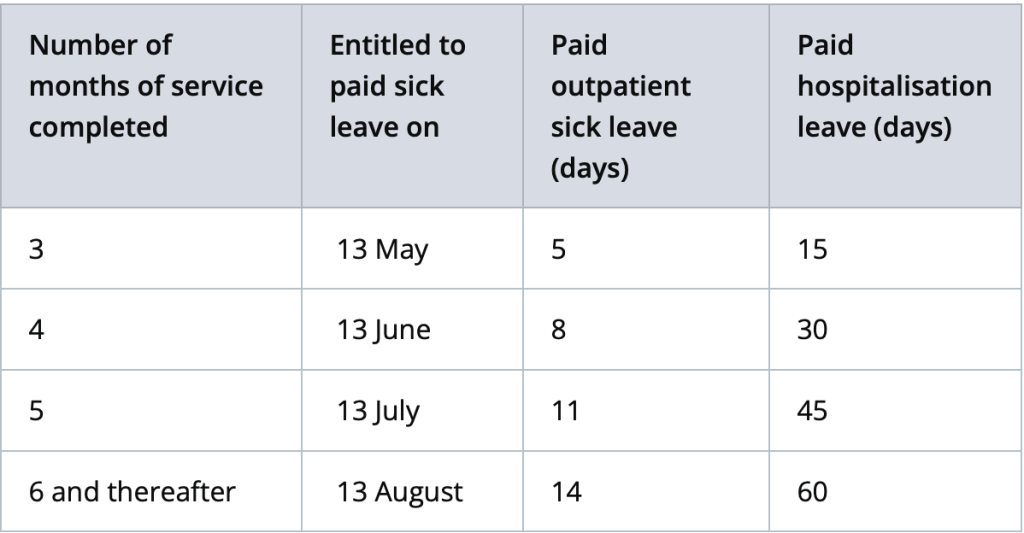
To be elibgible for paid medical leave and hospital leave, employees must have worked for the company for at least 3 months.
Similar to how Annual Leave is prorated for an employee who joins the company mid-way through the year, Medical Leave and Hospitalisation Leave are also prorated accordingly. However, one crucial difference between Annual Leave and Medical/Hospitalisation Leave is that while some companies may allow Annual Leave to be carried over to the next year, this is (understandably) not usually the case for Medical/Hospitalisation Leave.
It should also be noted that employees who have worked for at least 6 months are entitled to the full 60 days of Hospitalisation Leave and 14 days of Medical Leave.
Hospitalisation Leave Is Counted As Part Of The Notice Period
Hospitalisation Leave, Medical Leave and Annual Leave remain entitlements that an employee can utilise during the notice period. The scenario where Hospitalisation Leave is utilised during the notice period could come in cases where an employee is hospitalised for a critical illness and may need a long period of time to recover. In such cases, should the employee choose to leave their job, or should the employer choose to terminate the employment, the employee is entitled to take paid Hospitalisation Leave during the notice period.
Read Also: Medical Benefits That Businesses Have To Legally Provide For Their Employees In Singapore
Hospitalisation Leave Is Not Utilised For Public Holidays And Weekends
Similar to how Annual Leave and Medical Leave need not be taken for rest and non-working days, Hospitalisation Leave is not utilised for public holidays and weekends.
This means an employee on a 5-day work week can be eligible for up to 12 weeks of paid hospitalisation leave in a year. Should the employee require hospitalisation for a longer period of time, the employee can continue to take Hospitalisation Leave, but it will be unpaid.
Do’s And Don’ts When Taking Hospitalisation Leave
While intended to specify the minimum requirement, the employment contract is still fundamentally based on trust between the employer and employee. To ensure that this working relationship continues to function, it is best that both employers and employees treat each other fairly.
Do – Inform Employer ASAP
While the Employment Act stipulates that an employee can inform their employer up to 48 hours after the period they were supposed to turn up for work, this is meant primarily for situations where the employee is physically unable to do so, such as being involved in a car accident. In most cases, especially for taking Medical Leave or Hospitalisation Leave, it is likely that the employee or loved one can contact the employer.
Doing so helps the employer because they have some time to make the necessary alternative arrangements to reduce disruptions to workflow.
Do – Be Supportive Of Employee
While it’s a setback for any employer to down a worker for an extended period of time, the employee has to find a way to deal with the medical bill and make separate arrangements for their other family responsibilities. In most cases, hospitalisation is just a temporary setback, and the employee needs time to rest and recuperate.
Some ways for employers to deal with the temporary shortfall in manpower is to temporarily reassign some of the work to various colleagues or to hire some temporary manpower.
Don’t – Abuse Leave Privileges
For those who are on Hospitalisation Leave and recovering at home, it may sometimes be necessary to go out to buy necessities or to take a short walk. However, just like Medical Leave, it is best to properly rest during this period to speed up recovery. In addition, employees should not abuse their Hospitalisation Leave by going out shopping or for other recreational activities.
Subscribe To The DollarsAndSense Business Pass
Enjoy what you are reading and want more? Join The DollarsAndSense Business Pass and unlock access to valuable tools, exclusive networking opportunities, and tap into the wisdom of industry experts to fuel your business expansion!


