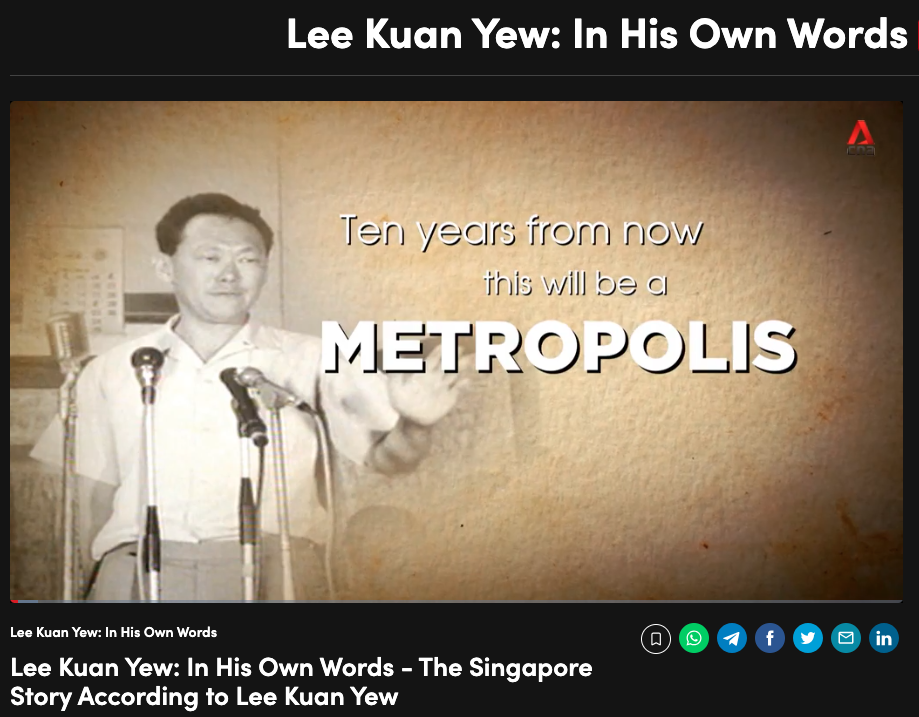
CNA recently released another brilliant video about Singapore titled, Lee Kuan Yew: In His Own Words. The video explores the early post-independence days of Singapore, seen through the lenses of our founding Prime Minister Lee Kuan Yew.
While the documentary is, in our opinion, a must-watch for every Singaporean to understand the history of Singapore and the early-day challenges that our young island nation had to overcome to become the economic powerhouse that we are today, it’s more than just a historical video.
Ever since our independence in 1965, the growth of Singapore over the past five decades has been outstanding. Within theLee Kuan Yew: In His Own Words documentary, we can learn some important lessons that can be applied to the business world.
All quotes below are taken from the documentary – Lee Kuan Yew: In His Own Words.
# 1 Have A Large And Well-Diversified Pool Of Customers
“We want to expand to America, Russia, Poland, Bulgaria, Europe, Britain, France, Australia, New Zealand, China, Hong Kong, Taiwan, Korea”
Rather than relying on just one or two major trading partners, Mr Lee Kuan Yew wanted Singapore’s economy to be well-diversified, with Singapore doing business with people and companies all around the world. As a small country with limited resources, having an open economy will allow us easier access to capitalise on the best business opportunities worldwide, and for Singapore to find its place in the global economy.
Today, Singapore’s trade-to-GDP ratio is more than 300% (337% as of 2022 according to The World Bank). This makes it one of the highest in the world, with only Luxembourg, Hong Kong and San Marino ahead of us.
Having a high international trade is good because it not only allows the country to enjoy better efficiency but also allows it to participate in the global economy. Both businesses and consumers also enjoy a greater variety of goods and services at more competitive prices, and it’s one way for us to export value-added services and goods we produce to other countries, while also importing and enjoying the fruits of the labours of other countries.
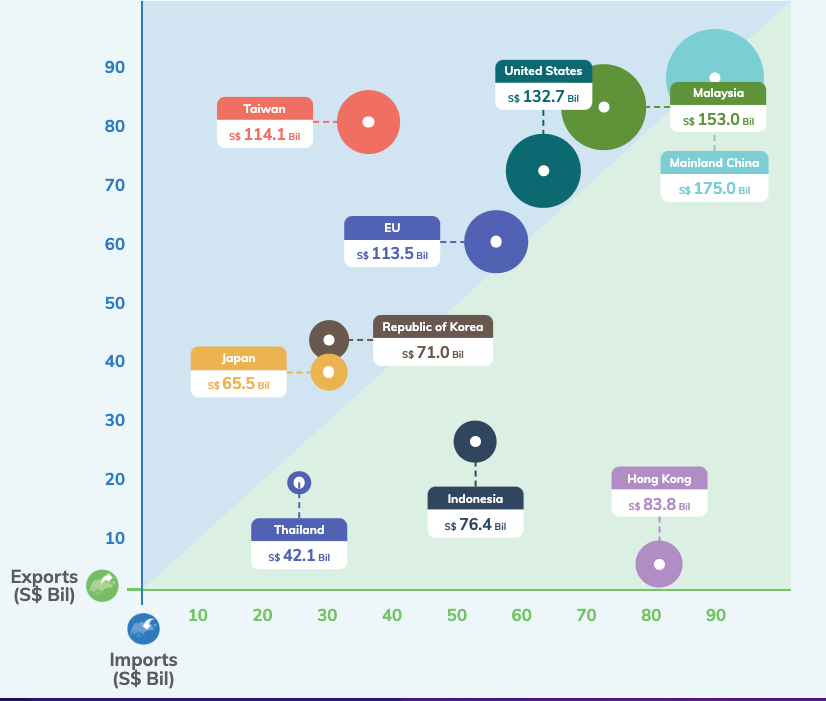
As seen above, the good thing about Singapore’s trade-to-GDP ratio isn’t just that it’s high, but that it’s also well-diversified across multiple major economies and some of our closest neighbours.
Within Southeast Asia, Malaysia, Indonesia, Thailand ranked as among our biggest trading partners. In the rest of Asia, we can count on Mainland China, Hong Kong, Taiwan, Japan and the Republic of Korea. Outside of Asia, the United States and the European Union (EU) are the biggest trading partners with Singapore.
Similarly for businesses, it pays to have a well-diversified pool of customers and clients, rather than just relying on only a few major customers. A diversified pool of customers will allow our business to be more resilient against the potential failure of any single big customer or client.
# 2 Change Is Usually The Only Constant
We are concerned. Because they feel their life have been upset. The pace of industrialisation, urbanisation, urban renewal, has brought about a change of not only a style of life, but their livelihood.
While Singapore’s economic progress grows strong, at an average of 13% by the late 1970s, it’s possible that not every person may be happy with the rapid transformation of our country. Changes are not something we may always be comfortable with.
To expand Singapore’s economy, there was a push in the 60s to develop labour-intensive industries. This led to labour shortage, which in turn, led to higher wages. Subsequently, Singapore started importing foreign talent in the late 1980s to early 2000s, as a way to supplement the local workforce.
From a business standpoint, and in my own view, it’s important to recognise that what brought us here, won’t necessarily bring us there. The world is constantly changing and for businesses to continue thriving, they will need to adapt to the changes and find new ways to stay ahead of their competition. Otherwise, they would likely become entities disrupted by newer competitors harnessing newer technology or new ways of doing things.
# 3 Human Capital Is What A Company Have
You’ve seen Singapore, the people here are a shooting stick made of steel.
While some countries are fortunate to have natural resources that they can rely on to power their economy, Singapore isn’t one of these countries. As many of us have learned since we were young, our only resource as a country is our people.
Similarly, for many companies, it’s the people in the organisation that would determine its future growth. Whether you are a media company, a FinTech firm or in the F&B industry, chances are that your most valuable asset as a company will be your people.
Even if our company owns patents that give our products and services an edge, we would still need the best people in our team for us to continue remaining ahead of the global competition we face.
# 4 Productivity Is Vital
The word is simple. It’s called productivity. Productivity means the ability to use men and machines in such a cooperative way that you produce more products per-man hour of superior quality than any other person can do, or any other group can do.
If we believe that our greatest asset as a company would be our people, then it goes without saying that their productivity would be vital to our business growth. Given the high cost of operating a business in Singapore, it’s essential for both companies and workers to continuously invest in their skills and knowledge to increase their productivity and wages.
To encourage companies to upskill their workers, schemes such as SkillsFuture For Enterprise are in place to help companies transform their workforce.
# 5 Don’t Ignore Succession Planning
Political leaders are judged, first by how effectively they have exercised their authority in the interests of their people. Second, by the way in which they are provided for continuity so that a successor government will continue to protect and advance the interests of their people. And third, by the grace with which they leave office and hand over to their successors.
Starting and growing a business is incredibly difficult. Often, founders and business leaders put so much effort into leading a business that they ignore the fact that the business itself would also have to be sustainable when they are no longer around. If a company is unable to continue performing when its key leaders are no longer around, whether due to resignation, retirement or health issues, then it might just be a company that has been built on a house of cards.
Prior to stepping down in 1990 as Prime Minister, Mr Lee Kuan Yew had two Deputy Prime Ministers alongside him. They were Goh Chok Tong, who served as Prime Minister from 1990 to 2004, and Ong Teng Cheong, who was Singapore’s President from 1993 to 1999.
Similarly for businesses, succession planning is critical if we desire to build a business that can survive when we are no longer working in the company. Often, this requires a deliberate intention for companies to identify, groom and retain future leaders that would lead the company.
Read Also: What Happens When A Business Owner Passes On?
Beyond historical and business lessons, the Lee Kuan Yew: In His Own Words documentary is a fantastic video to watch for anyone who wishes to understand how Singapore’s transformation happened and why things in Singapore are happening in the way they are today. You can watch this video on the CNA YouTube channel.
Subscribe To The DollarsAndSense Business Pass
Enjoy what you are reading and want more? Join The DollarsAndSense Business Pass and unlock access to valuable tools, exclusive networking opportunities, and tap into the wisdom of industry experts to fuel your business expansion!