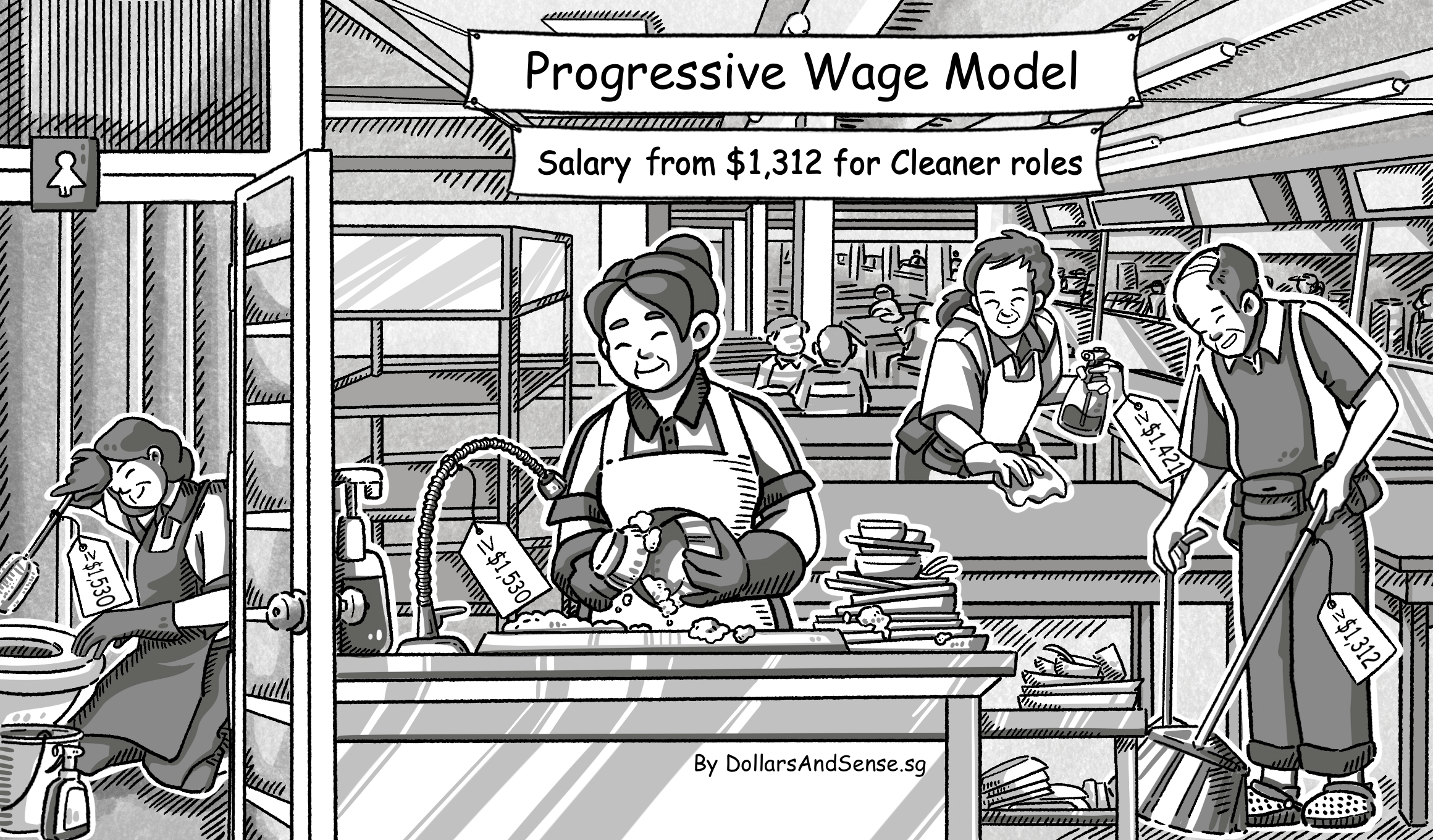
Cleaners in Singapore may not be as highly paid as those in developed countries, but the rolling out of the progressive wage model (PWM) attempts to standardise the salaries for the cleaning sector here and uplift their salaries.
In Singapore, about 40,000 resident cleaners are employed by over 1,500 cleaning businesses. Following the onslaught of the Covid-19 pandemic, there is a greater emphasis on uplifting the cleaning sector as the workers have contributed to keeping the country safe and protected from the virus.
The PWM for the cleaning sector was developed by the Tripartite Cluster for Cleaners (TCC). It comes under the Cleaning Business Licence scheme administered by National Environmental Agency (NEA). Cleaning companies must meet the PWM requirements to obtain or renew their licences.
The PWM for the sector is staggered over the course of six years. For example, general cleaners in Singapore earn the minimum sum of $1,312 per month for 2023 but will earn a salary that exceeds $2,400 by 2029.
Read Also: 4 Tips To Improving Ventilation And Indoor Air Quality In Your Workplace (According To NEA)
Who Does The PWM Cover?
From 1 September 2022, employers hiring foreign workers are required to meet the PWM requirements for their in-house cleaners.
The PWM requirements are mandatory and cover all Singapore Citizens and Permanent Residents employed in outsourced cleaning jobs, or in-house cleaning jobs in firms that hire foreign workers.
Employers are encouraged to adopt the PWM principles for their foreign cleaners by upgrading their skills and implementing productivity-based wage progression pathways.
The progressive wage structure comprises three wage ladders for three broad categories of cleaning jobs:
| Cleaning Categories | |
| Group 1 | Office and commercial sites (e.g. offices, schools, hospitals, medical clinics, condominiums) |
| Group 2 | Food and beverage (F&B) establishments (e.g. hawker centres, food courts, restaurants) |
| Group 3 | Conservancy (e.g. town councils, public cleansing) |
These categories account for the most common types of cleaning jobs.
What Are The Wage Requirements
The wage requirements are staggered over a six-year schedule to maintain sustained wage increases.
Eligible outsourced and in-house cleaners will get a PWM bonus of at least two weeks of basic monthly wages each year.
In-house resident cleaners will be paid a basic monthly salary of:
- More than $1,312 for general cleaners
- More than $1,530 for outdoor cleaners/restroom cleaners
- More than $1,967 for supervisors/mechanical drivers
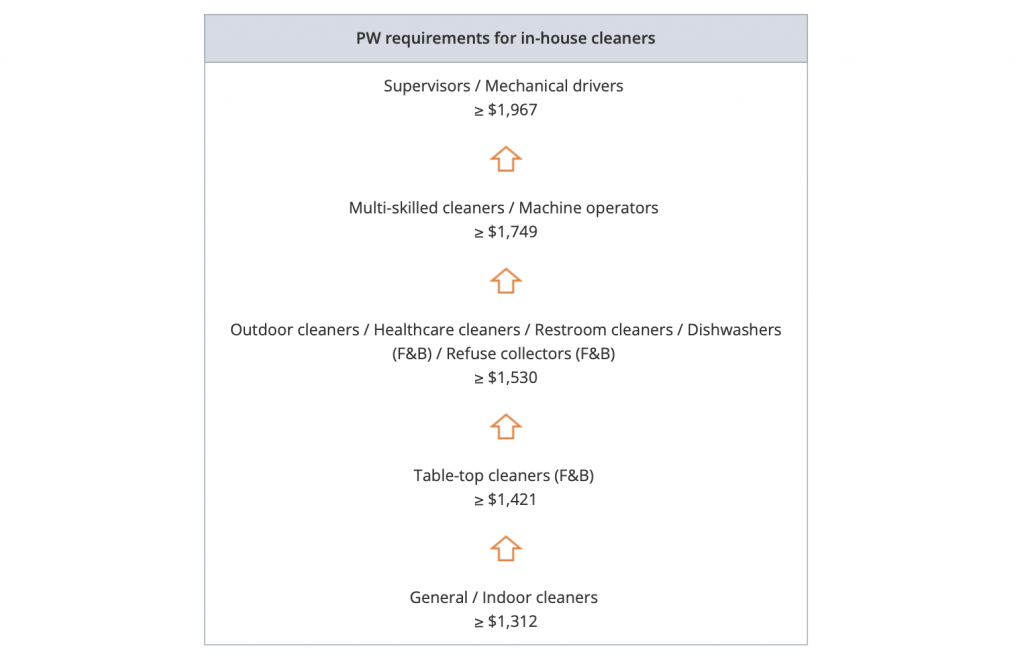
From 1 July 2022 to 30 June 2023, outsourced resident cleaners must be paid the following basic monthly salary:
Office and commercial sites and f&b establishments:
- Equal or more than $1,312 for general cleaners
- Equal or more than $1,530 for restroom cleaners
- Equal or more than $1,749 for multi-skilled cleaners
- Equal or more than $1,967 for supervisors
Conservancy areas:
- Equal or more than $1,530 for general cleaners/restroom cleaners
- Equal or more than $1,749 for multi-skilled cleaners
- Equal or more than $1,967 for supervisors/mechanical drivers
- Equal or more than $2,077 for truck drivers
Cleaners who are more skilled and can conduct specialised cleaning – such as healthcare cleaners, dishwashers, and refuse collectors – earn at least $200 more than general cleaners.

The amount increases every subsequent year until 2029:

In summary, a general cleaner will get a pay increment of almost 100% by 2029, at $2,420. Meanwhile, a restroom cleaner will earn almost double his/her salary to $2,835 by 2029.
With the new wage schedule, the compound annual growth rate of a general cleaner’s pay will be 10.7% from 2023 to 2028.
The staggered increase is to help businesses adjust to the changes but businesses at all venues that require cleaning services are likely to deal with increased labour and operating costs.
Read Also: Local Qualifying Salary: 5 Things You Need To Know About LQS
Does The PWM Also Apply To Part-Time Or Temporary Workers?
All cleaners who are Singapore Citizens or Permanent Residents are eligible for the PWM. Part-time workers will be pro-rated based on the PWM basic wage paid to a full-timer with a similar job scope.
Are There Any Qualifying Training Requirements
For outsourced cleaners, cleaning companies have to ensure that their cleaners meet the PWM training requirements.
In-house cleaners have to meet at least 1 Workforce Skills Qualification course or 1 in-house training programme.
Beyond 2025, general cleaners or those in lower roles have to get at least three Workforce Skills Qualification Certificates in Environmental Cleaning Modules while those in higher roles must complete four modules.
The benefits of having cleaners upgrade in skills include increased productivity and better quality cleaning services. More training requirements are expected for the cleaners going forward, as their salaries increase are the expectations for them to perform better climb.
What Happens When The Employer Doesn’t Follow The PWM Requirements
Employers in the cleaning sector must follow the PWM in order to be licensed or to be able to renew their licences.
Workers who are not given the correct salary can also report violations to the Manpower Ministry if:
- The employment contract does not reflect the correct wage level and/or
- If the employment contract reflects the correct wage level but the worker is not paid according to the contract.
Subscribe To The DollarsAndSense Business Pass
Enjoy what you are reading and want more? Join The DollarsAndSense Business Pass and unlock access to valuable tools, exclusive networking opportunities, and tap into the wisdom of industry experts to fuel your business expansion!


